Multi-Unit Architectural Controls
Architectural Controls | |||
|---|---|---|---|
| These architectural controls apply to all multi-unit dwellings. All multi-unit dwellings must receive approval from Saskatoon Land through an architectural review prior to applying for a building permit. Architectural review submissions must address the items listed below. | |||
| 1.0 Introduction | 5.0 Fenestration | 9.0 Parking, Loading, & Service Areas | 13.0 Fee-Simple on Multi-Unit Parcels |
| 2.0 Proportion, Scale, & Massing | 6.0 Roofs | 10.0 Site & Building Exterior Lighting | |
| 3.0 Walls & Materials | 7.0 Relationship to Streetscape | 11.0 Mechanical/Electrical | |
| 4.0 Colour | 8.0 Variety | 12.0 Landscaping | |
Summary of Key Architectural Controls
- The intention of implementing Architectural Controls is not to control building styles but rather to reduce the potential for the visual monotony often associated with multi-unit developments. This can be achieved by breaking up large volumes of uninterrupted roof planes, the breaking up the featureless planes associated with large multi-unit wall areas, the careful use of more than one cladding material, the use of trim details, and the use of several colour schemes each containing more than one or two colours.
- On a group townhousing site or an apartment-style building site, the buildings adjacent to the front property line is required to front onto the public street. This required layout is similar to the way a street townhouse fronts onto a street.
- Where possible, townhouse sites may orient garages across the street from single-unit housing with front garages. It is also subject to approval during the Development Review Process addressing technical site and other City Policy considerations.
- Large volumes of roofs or walls need to be broken up with architectural detailing that significantly reduces large expanses of featureless plane.
- All buildings require, at the very least, two major cladding materials.
- Any building’s colour scheme needs, at the very least, four colours of which two are major colour applications. The two major colours will be associated with the major cladding materials. The two other colours will be associated with the roof colour and minor architectural detailing such as soffit, fascia, doors, door trim, and window trim. In the case of townhousing, adjacent buildings require different colour schemes.
- Wall cladding materials are required to extend a minimum of 1.2 metres (4 feet) alongside building elevations that do not face public streets, public parks, or adjacent developments.
- Any facade abutting and/or highly visible from a public street, public park or adjacent development shall receive the same architectural treatment as the “front” facade.
- All mechanical equipment, garbage or recycling receptacles, must be suitably screened. Chimneys or other venting pipes must be clad in chimney chase.
1.0 Introduction
This document outlines the general architectural design requirements for the Multiple-Unit Dwelling Districts being developed by the City of Saskatoon. Architectural Controls concern the position of buildings on sites, the proportion, scale and massing of buildings, the application of materials and colours to exterior walls and roofs, and the choice and location of windows and doors.
An architectural style is not prescribed. Instead, projects should satisfy the overall human-scale architectural vocabulary as outlined in these architectural controls. Varying architectural interpretations are encouraged.
These Architectural Controls are intended to supplement the City of Saskatoon Zoning Bylaw No. 8770. Developments are expected to be governed by Bylaw No. 8770 in combination with the Architectural Controls. In the event that there are contradictions between these two documents, Zoning Bylaw No. 8770 will govern.
If a multi-unit parcel is designed for one, two, or semi-detached dwellings, the single-unit Architectural Controls and these multi-unit Architectural Controls will be combined and used during the Plan Approval Process.
The intent of this document is:
- To promote architectural detailing; not to prescribe style;
- To influence the application of more than one colour palette; not to prescribe colour; and
- To influence the application of more than one material; not to prescribe material.
2.0 Proportion, Scale, and Massing
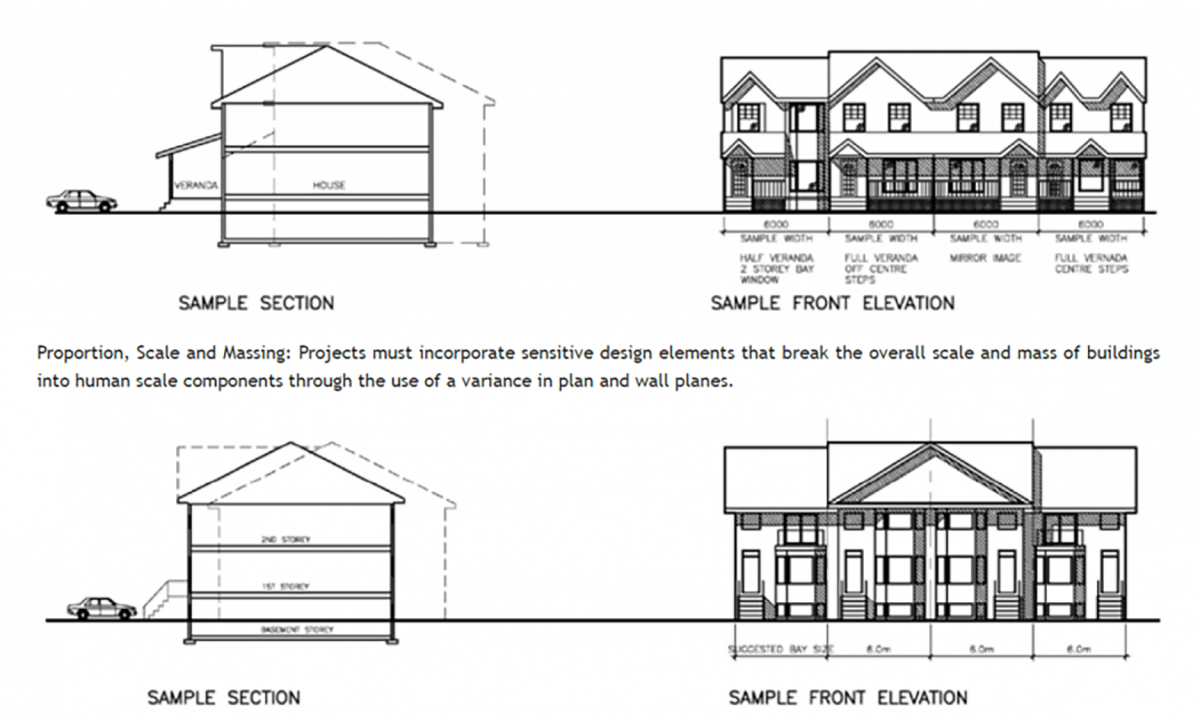
INTENT: New developments should be well proportioned, integrate with neighbouring buildings, and incorporate design elements that break down perceived proportion, scale and massing of building elements to create human-scaled pedestrian-environments and enjoyable streetscaping.
- Developments should utilize existing or “natural” grade, to assist them in blending with adjacent developments. Grade alterations can create negative impacts on adjacent properties.
- All multi-unit buildings should be positioned to enhance the streetscape by creating what may be described as a street wall.
- All building volumes must incorporate intermittent variances in plan and elevation to encourage shadow lines on the building and to assist in breaking down the apparent mass and scale into well-proportioned volumes. This includes building elevations that are adjacent to or visible from public streets, public parks, and adjacent developments.
- Construct buildings to define the edges of, and to face onto, any public park and/or accessible open spaces.
STREET WALL
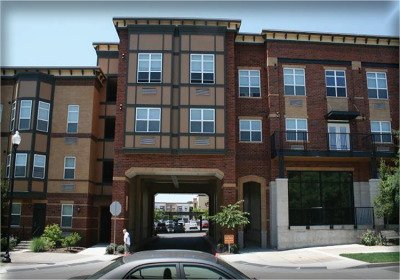
A Street Wall refers to the alignment of building facades that face the street. A well-designed street wall creates a welcoming pedestrian environment through defining a walkable, pedestrian-friendly space.
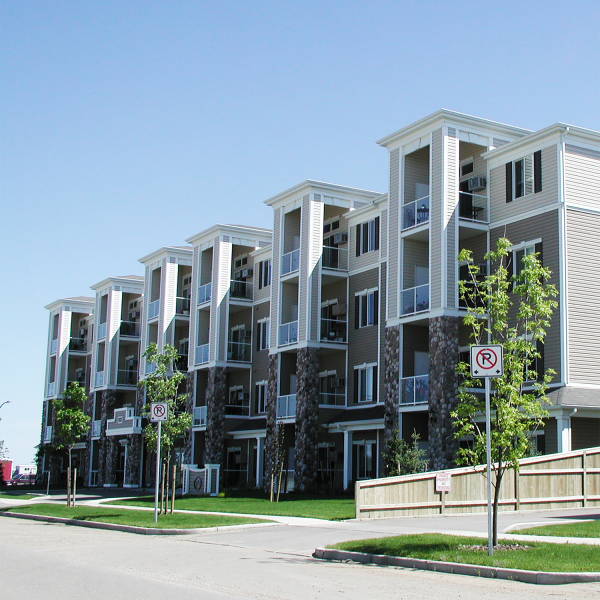 |
| Above: The above image demonstrates a building facade that interfaces well with the street, creating a pedestrian-friendly space. |
IN GENERAL...
- The majority of the principal building(s) main façade should be located so it is parallel to a straight public street or tangent to a curved public street.
- Open space is permitted between the principal building(s) fronting a public street provided that the total linear amount of building façade exceeds the total linear amount of open space as measured along the same property line.
- The sides of groupings of principal and accessory buildings are permitted to front onto public streets, providing the total linear amount of side elevations are less than the total linear amount of principal building facades fronting the same street. Where side elevations front onto a public street, the side elevations must receive the same architectural treatment as the principal facade.
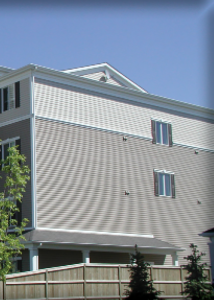 | 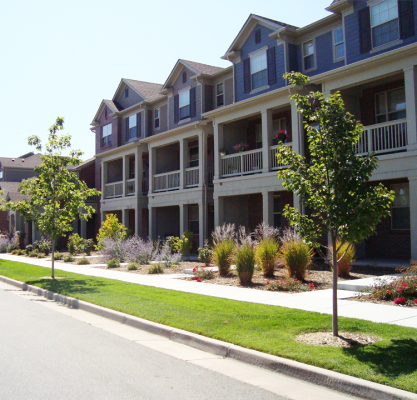 |
| Above: This building demonstrates an unacceptable building facade facing a public street. Additional design treatments are required. | Above: Buildings that are aligned with adjacent streets ensure a site configuration that creates streets with pleasing streetscapes and enhances the image and feel of the neighbourhood. |
3.0 Walls & Materials
INTENT: To create a visually pleasing streetscape and reduce visual monotony, a variety of materials are to be used as well as materials that complement those used in adjacent developments.
- A minimum of two major exterior cladding materials, excluding fenestration, are required for any elevation of a principal or accessory building adjacent to or visible from a public street, a public park, or adjacent development, the proportions of which must be sensitively designed.
- In the case of most materials, except for vinyl siding or cement board siding, the use of two discernible colours, two discernible textures, or combinations thereof of the same material are acceptable as meeting the requirements. In the case of vinyl siding or cement board siding, consideration will be given to two significantly different material patterns in a case where a relatively smaller proportion of a third material (greater than 30% of a third material) is used. For example, a material application may be accepted if visible building elevations were proposed to contain 3 materials – 30% stone and 70% vinyl siding whereby straight horizontal overlapping vinyl panels were heavily accented with vinyl “fish scale” panels.
- Required architectural detailing applies equally to all building elevations including where the side and rear of a principal building or an accessory building is adjacent to or visible from, any public street, public park, or adjacent development.
- Walls clad in a single material are not permitted.
- Durable high-quality materials should be utilized for cladding on all building faces.
- Wall cladding materials are required to extend to a minimum of 1.2 metres (4 feet) alongside building elevations that do not face public streets, public parks, or adjacent developments.
- Where properties share a common property line, each property must have different materials or combinations of materials.
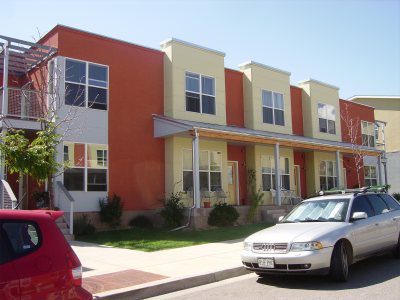 | 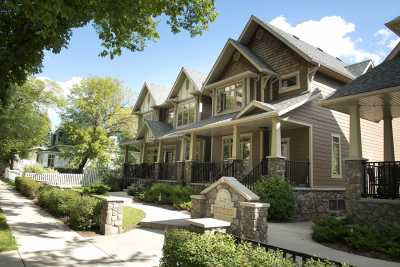 | 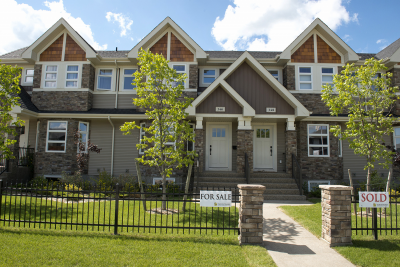 |
| Above: Each of the above images demonstrates a minimum of two exterior cladding materials with sensitively designed proportions. | ||
4.0 Colour
INTENT: Variety of colour is necessary for multi-unit projects to create lively streetscapes and to prevent the creation of visual monotony.
Dwelling group or street townhouse STYLE BUILDINGS:
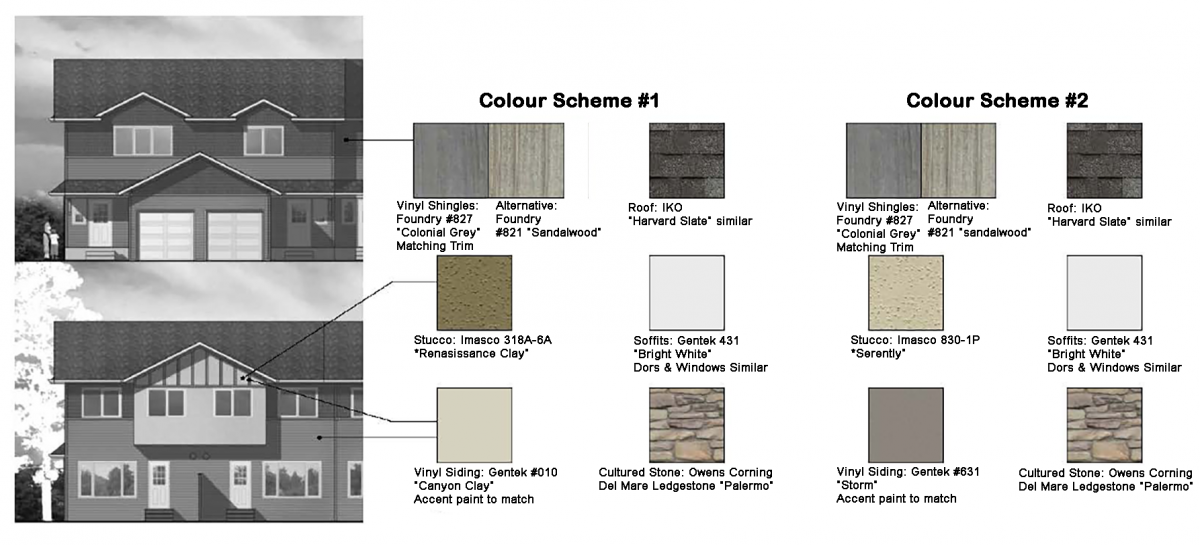
Colour should vary from building to building within developments. A minimum of two exterior colour schemes for each multi-unit parcel must be implemented. A minimum of two major colours are required to be utilized in the colour scheme of each building facade adjacent to or visible from any public street, public park, or adjacent development (excluding roof colours and colours utilized for minor architectural components such as soffit and fascia, window and door trim etc). A minimum of four colours should be utilized on any one building colour scheme. This includes the roof colour and the colours of minor architectural components. In order to qualify, colours must be visible from any street.
APARTMENT STYLE BUILDINGS:
One exterior colour scheme is permitted per site that has more than one building. A minimum of two major colours should be utilized on each building facade adjacent to or visible from any public street, public park, or adjacent development (excluding roof colours and colours utilized for minor architectural components such as soffit and fascia, window and door trim etc). A minimum of four colours should be utilized on any one building. This four colour minimum includes the roof colour and the colours of minor architectural components. In order to qualify, colours must be visible from any street.
GENERAL REQUIREMENTS:
- Accessory buildings should be treated in a complimentary fashion to the principal buildings on the same site. Where different multi-unit parcels share a common property line, each parcel must have different colour schemes.
- A minimum number of colours is prescribed to ensure more than one colour is used on each façade.
- Readily discernible shades of one colour, when viewed from any street, may be considered two separate colours.
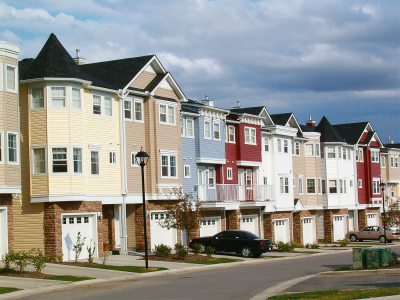 |  |
| Above: Street townhouse utilizing a variety of colours | Above: Example of colour palates meeting the minimum of four colours within a colour scheme. |
COLOUR SCHEME EXAMPLE
5.0 Fenestration - Windows & Doors
INTENT: Fenestration should be oriented to streets and/or public spaces, complement the architectural vocabulary, and satisfy functional and climatic issues. Abundant glazing at street level is encouraged for community surveillance and to enhance street lighting at night.
- Readily discernible trim must be utilized around highly visible doors and windows.
- Blank walls without fenestration at street level or upper levels will not be permitted on facades adjacent to or visible from public streets, public parks, or adjacent development.
- If glazing tints are used, they should reflect the choice of colours of wall and roof claddings. Reflective coatings are not permitted.
- If imitation shutters are utilized, they are required to be proportioned to give the impression that they are functional and capable of covering the entire window.
- Developments are encouraged to have main entrances facing public streets.
6.0 Roofs
INTENT: Roofs should be designed to form an integral part of any project and complement the overall architectural design. Where exposed roof surface areas are large, it is mandatory to incorporate sensitive design elements that break down perceived proportion, scale and massing of the roof to create human-scaled surfaces.
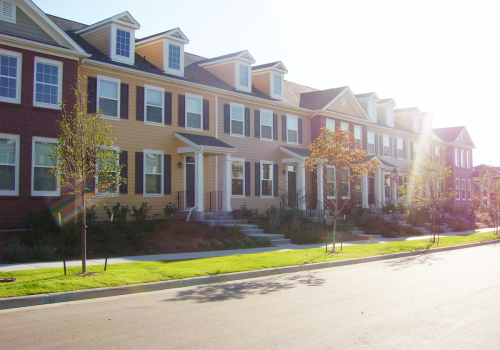 | 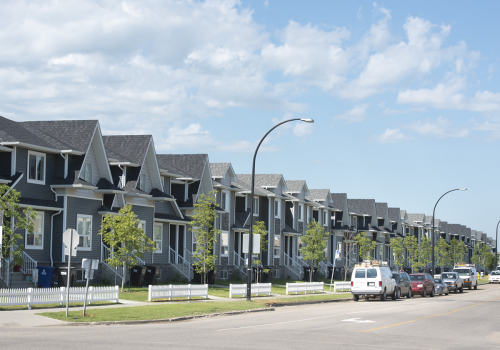 | 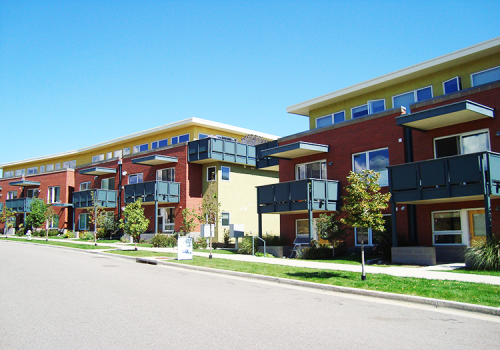 |
| Above: Example of dormers that break large roof plane. | Above: Example of varied roof planes to break up viewing plane. | Above: Example of a flat roof. |
- The exposed roof area when calculated perpendicular to a vertical viewing plane should not exceed 40% of the total projected wall and roof area. Alternatively, large roof areas should be broken down into smaller volumes by varying the roof planes, or by introducing sensitive design elements such as dormer windows.
- Sloped roofs should have a minimum overhang of 450 mm or 18 inches. Fascia boards should be a minimum 150 mm or 6 inches. Permitted claddings for sloped roofs include pre-finished steel standing seam roofs complete with snow and ice stops, asphalt shingles, cedar shingles/shakes, granular faced aluminum shingles, clay or concrete tile roofing and glazing.
- All chimneys visible from any street should be enclosed within a chimney chase. The form, style, materials and color of the chimney chases should be consistent with the overall architectural character.
7.0 Relationship to Streetscape
INTENT: Multi-unit building facades facing public streets should help define the streetscape through thoughtful design and sensitive architectural treatments.
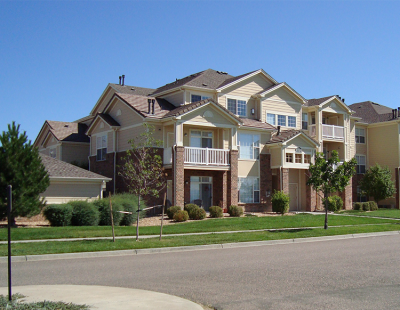 | 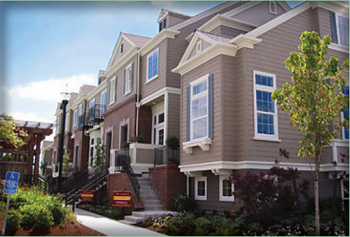 |
| Above: Good examples of buildings interfacing with public street. | |
- Create a street wall with the majority of the staggered main facade located parallel to straight streets or tangent to curved streets.
- Wherever possible, front and side elevations should front onto public streets. In event that it is not possible, sensitive design treatments may be required in order to create a visually pleasing streetscape.
- Any facade abutting and/or highly visible from a public street, public park or adjacent development shall receive the same architectural treatment as the “front” facade.
- Property lines adjacent to streets must be fully landscaped.
- Street or group townhousing units that are visible from a public street are required to include a significant entry treatment.
- In general, private exterior open space in the form of verandas, porches, balconies, patios, and/or roof terraces are strongly encouraged for as many residential units as possible.
- For Dwelling Groups, main entrances to each unit do not have to face a public street, however, secondary entrances facing public streets should be architecturally well defined.
- In general, connections to existing public space and amenities from multi-unit buildings are encouraged (i.e. walkways linking to sidewalks and/or park pathways).
FENCING
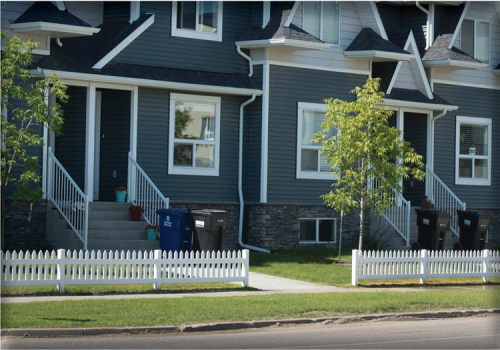 | 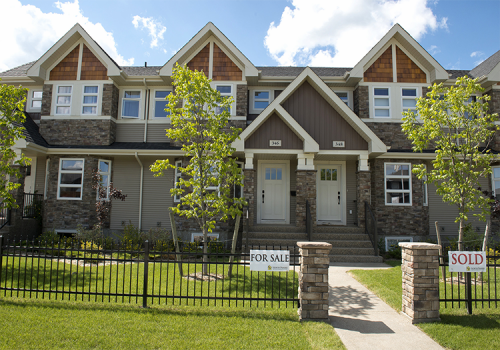 |
| Above: Examples of acceptable front yard fencing | |
Fencing is not required. In the event that a fence is desired, the below guidelines should be considered:
- If a front yard fence is constructed of wood, steel, aluminum, or wrought iron, the amount of solid area of the fence sections shall not exceed 50%.
- Fence piers or fence sections constructed of natural stone, manufactured stone, brick, or some other masonry application may be 100% solid.
- In the case of street or group townhousing, a front yard fence is required to have an access opening or gate to the street from each front door. Where a solid fence fronts onto a public street and encloses an open space between a principal and accessory building, the cladding materials requirements for principal and accessory buildings shall relate to the fence.
8.0 Variety
INTENT: A variety of architectural styles, spaces, colours, materials and uses are encouraged within the neighbourhood.
- Where properties share a common property line or are in close proximity to each other, each property is encouraged to demonstrate architectural variety to decrease visual monotony.
- Repetition of architectural styles on separate development sites that are in close proximity to each other is strongly discouraged.
9.0 Parking, Loading, and Service Areas
INTENT: Balance the need to improve the pedestrian environment with the demand for parking. Parking should not dominate the streetscape or individual sites.
 | 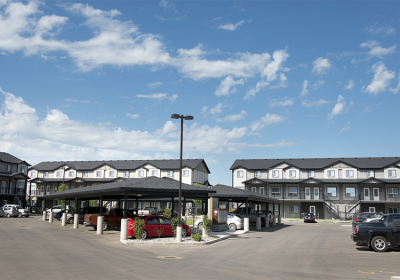 |
| Above: Example of parking suitably screened from public view by locating it in the interior of the building site. | |
- For all developments, required parking is not permitted in front yards. Required parking must be located within or under the development or in a rear yard or side yard and suitably screened from adjacent public streets, public parks, or adjacent development.
- Access to all multi-unit parcels (not individual dwellings) is acceptable from public streets.
- Where possible, dwelling group sites may orient garages across the street from single-family housing with front garages, subject to approval during the Development Review Process addressing technical site and other City Policy considerations.
10.0 Site & Building Exterior Lighting
INTENT: Buildings and sites should be illuminated for security and ambience. Night lighting encourages activity, but any potential for “light pollution” is to be avoided.
Lighting on any site and on/in any portion of a building shall be arranged and shielded such as that it does not become a hazard or annoyance. Lighting should not in any way compromise the appropriate function of adjacent properties.
11.0 Mechanical/Electrical
INTENT: Screen mechanical and electrical equipment that is normally left within view of the street on sites and on rooftops. Noise generated by this equipment must be considered such that adjacent occupancies are not impacted.
Excluding any existing utility, mechanical and electrical equipment on a site or on a building must be adequately screened from adjacent street level.
12.0 Landscaping
INTENT: To encourage professionally designed solutions to link to streetscapes and public spaces with the Neighbourhood.
- Open space must be landscaped. All development submissions must be accompanied by general landscape concept plans (not Landscape Rendering).
- In the case of soft landscaping that is visible from any public street, lane or park, grass may only be used for 75% of the soft landscaping provided on any site. This must be demonstrated on plan either graphically or in text format.
- Landscapes must be designed to be self-sustaining in the local climate or an adequate irrigation system is to be provided.
- Coniferous trees must be a minimum of 1800mm height and deciduous trees must have a minimum calliper of 50mm at the time of installation.
- Landscaping is to be extended into the City boulevard where the site is adjacent to separate sidewalk and curb.
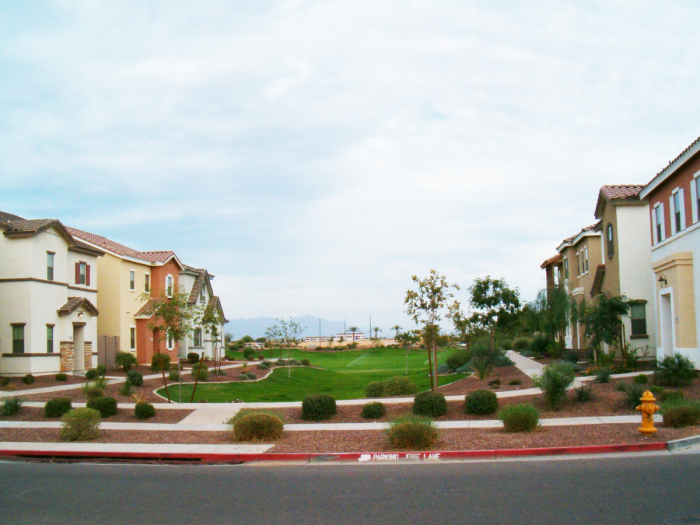 |
| Above: Multi-unit buildings front on common space that contain self-sustaining landscaping. |
13.0 Fee-Simple on Multi-Unit Parcels
1. Massing & Relief
All dwellings must incorporate intermittent variances in plan and elevation to encourage shadow lines on facades and visible elevations which will enhance the streetscape by introducing interesting architecture. This includes all dwelling elevations that are adjacent to or visible from public streets, open spaces, and adjacent parcels.
Dwellings should utilize existing grade, to assist them in blending with adjacent parcels. Grade alterations can create negative impacts on adjacent parcels.
2. Repetition
The same elevations should not be repeated on adjacent dwellings or where dwellings share a common property line or are in close proximity to each other, each dwelling is encouraged to demonstrate architectural variety to decrease visual monotony. If multiple dwellings are adjacent to each other or across the street, three to five different front elevations are required. Examples of acceptable changes in architectural detailing could include a combination of, but are not limited to the following: roof and dormer orientation and slope, front attached garage roof style or orientation, the size and location of windows and doors, window grilles, material colours and finishes. Two-unit dwellings, townhouses, or dwelling groups shall include unique rooflines and distinct features such as siding material changes, design differences, massing changes, and colour variation for each individual unit.
3. Dwelling Size
No dwelling shall be constructed which has an above-grade floor area (excluding attached decks, patios and garages) less than:
a. 800 square feet in the case of a bungalow, or bi-level dwelling; or
b. 1,000 square feet in the case of a two-storey dwelling.
For duplex or semi-detached, these minimum floor areas apply to each dwelling. Split-level dwellings are NOT permitted.
4. Front Entry
Front Door Placement
It is encouraged that the front door of a dwelling be visible on the front facade by directly facing the fronting street. If the door does not face the street, a combination of architectural elements such as front window enhancements, verandas, additional front accent materials or other architectural elements must be added to enhance the dwelling entrance.
Depending on Saskatoon Land’s evaluation of any submitted plans, especially those that satisfy only the “minimum” requirements, Saskatoon Land may require architectural details such as the following:
- Accented wall build-outs or interruptions in wall planes.
- Window and door accents.
- Break-ups in roof massing or roof lines such as dormers or cross gables.
- Other accents or placement of material or colour.
Columns, Stairs & Entry features
Each dwelling requires an architecturally significant entry feature consistent with that dwelling's overall architectural style. This may include the use of covered verandas, modern contemporary interpretations of pergolas, or covered entry features.
If columns are used, column styles should be consistent with the overall architectural style of the dwelling. This might include the use of wide-based, tapered columns with stone detailing at the column base for craftsman style dwellings, cedar-clad columns for modern contemporary style dwellings, or columns with masonry cladding along the full length of the column for traditional-style dwellings. The minimum width for any front entry columns should be 8 inches, and wrapped with approved cladding.
Stairs, landings and verandas must be enclosed on all sides. Using steel risers on stairs is permitted as long as the steel is not visible and encased by wood. Untreated plywood or OSB (not painted or stained) are not acceptable enclosure materials.
5. Exterior Materials
Walls clad in a single material are not permitted. All dwellings require a minimum of two different exterior building materials on the front elevation, with each material being no less than 50 square feet in area, or a minimum of three exterior building materials with each material being no less than 25 square feet in area.
Wall cladding materials are required to extend to a minimum of two (2) feet alongside dwelling elevations that do not face public streets or open spaces.
See Highly Visible Lots section below to determine if additional side or rear elevation materials are required. For duplexes and semi-detached, each dwelling must meet or exceed the minimum exterior building material requirements noted above.
6. Colours
Colour should vary from dwelling to dwelling within parcels. A minimum of three to five exterior colour schemes for each parcel must be implemented and these schemes should alternate between adjacent dwellings. A minimum of two major colours are required to be utilized in the colour scheme of each dwelling facade adjacent to or visible from any public street, open space, or adjacent parcel (excluding roof colours and colours utilized for minor architectural components such as soffit and fascia, window and door trim, etc). A minimum of four colours should be utilized on any one dwelling colour scheme. This includes the roof colour and the colours of minor architectural components noted above. In order to qualify, colours must be visually different when viewing the dwelling from the street.
7. Fenestration - Windows & Doors
Fenestration should be oriented to streets and/or public spaces, complement the architectural style, and satisfy functional and climatic issues.
- Readily discernible trim should be utilized around highly visible doors and windows.
- Blank walls without fenestration will not be permitted on facades adjacent to or visible from public streets and open spaces.
- If imitation shutters are utilized, they are required to be proportioned to give the impression that they are functional and capable of covering the entire window.
- It is encouraged to have the front door directly facing the fronting street.
8. Roofs
There is no roof pitch requirement; however, the roof pitch should complement the architectural style of the dwelling and be consistent with the intent of strengthening the streetscape and harmonizing the interface between dwelling forms.
Approval of roof pitches will be at the discretion of Saskatoon Land.
9. Garages
Corner Lots
For attached garage dwellings on corner lots, the garage must be located as per the permitted garage sides as shown below. The image below demonstrates permitted options for the placement of an attached garage on a corner lot, attached to the front of the dwelling furthest from the street corner or attached to the rear of the dwelling closest to the side street.
Builders must check curb design, street light pole locations, utility pedestal locations, and mailbox locations, prior to designing a dwelling with a garage access from the side street.
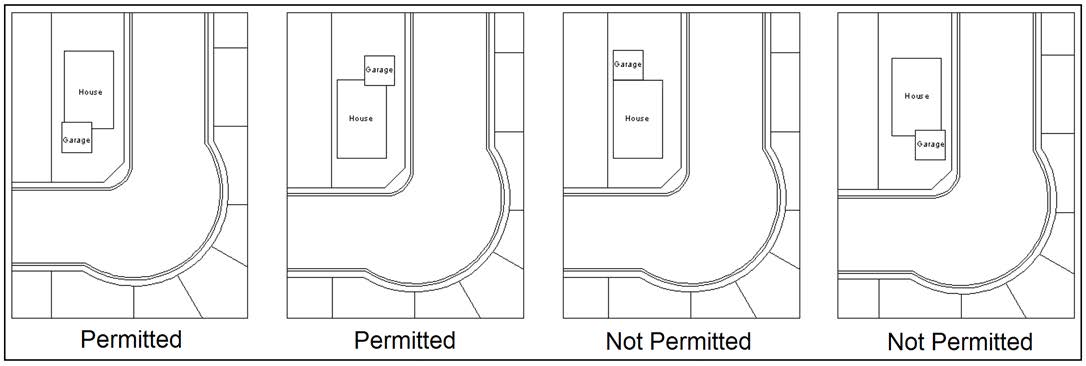
Attached Garage Option
Garage sides on a given parcel should be paired together against a common property line in order to provide a better streetscape appearance.
Dwellings must be constructed with a minimum single-wide attached garage. The garage must be constructed at the same time as the dwelling is built. Minimum inside dimensions shall be 3.5 metres wide and 6.0 metres long.
Architecturally Significant Garage Doors: The street appeal of a dwelling contributes to the general appeal of any residential area. Front attached garage doors make up a significant portion of the facade of any dwelling.
Any dwelling with a front or rear attached garage that faces the street requires garage door styles that complement the dwelling’s exterior. Garage door colors must vary so that no more than two consecutive dwellings have the same color. If garage doors without windows is desired, the following could be considered:
- Full-width windows or trellis above garage doors are permitted and count towards the garage door architectural elements.
- Wood tone garage doors (without windows) are permitted if the wood tone garage door compliments a structural architectural element on the dwelling such as columns or exposed beams.
- Contemporary or Flush garage doors or garage doors that use hardware and handles (without windows) may be approved if the garage door style is consistent with the dwelling style and only if no adjacent dwelling has been previously approved to have a garage door with no architectural elements or similar hardware.
Detached Garage Option
Dwellings considering detached garages must be constructed with a concrete garage pad with access from the rear lane at minimum. The concrete garage pad must be constructed at the same time the dwelling is built with a minimum dimension of 3.5 metres wide and 6.0 metres long. The garage pad shall NOT be built on the rear easement and must include a paved apron that connects the garage pad to the rear property line.
For laned corner lots, all dwellings must be constructed with a minimum 3.5 metres wide and 6.0 metres long garage. The garage must be constructed at the same time as the dwelling is built. See Highly Visible Lots section below for more details.
10. Landscaping Requirements
Front yard landscaping is mandatory to improve the curb appeal of newly built dwellings in the neighbourhood. Landscaping is to be extended into the City boulevard especially where the site is adjacent to separate sidewalk and curb. On corner lots, landscaping must be completed for the entire length of the side-yard boulevard which abuts the flanking street.
Landscaping of boulevards must be completed using topsoil and sod only and be connected to the irrigation system if an irrigation system is installed.
The material scope includes materials and services rendered for the installation of sod, topsoil, trees, shrubs, plant materials, hardscape elements, irrigation components, and edging.
The following minimum standards apply for each parcel:
- Topsoil installed to a minimum depth of 100mm;
- Sod (seeded lawns are not acceptable) “Sod laying shall be performed during the active growing season for type of sod. Sodding during dry periods, at freezing temperatures or over frozen soil is unacceptable.” Canadian Landscape Standards, 2017; and
- Please refer to Zoning Bylaw No. 9990 for tree landscaping requirements; however, Saskatoon Land encourages at least one (1) tree and (3) three shrubs/tall grasses of a species suitable for Saskatoon's climate and soil types to be planted in the front yard of each dwelling.
- Deciduous trees must have a minimum 45mm caliper measured 1.8m above ground;
- Coniferous trees must be at a minimum 1.8m in height.
11. Front Attached Driveway Requirements
For front attached garages, a front driveway is mandatory. The acceptable driveway types are the following:
- Broom-finished;
- Stamped and coloured; or
- Exposed aggregate and pavers
Driveways are to be extended into the City boulevard especially where the site is adjacent to separate sidewalk and curb. The width of a driveway must not be the same width as the lot as some portion of the front yard must be landscaped. Contact Saskatoon Land to complete a preliminary review for narrow lots with limited frontage.
12. Highly Visible Lots
The controls below only apply to dwelling elevations that are highly visible from streets and open spaces in addition to the front dwelling elevation. These controls are in addition to the controls noted in the previous sections. The intention of these controls is to avoid the monotony and the undesirable appearance of large expanses of blank walls on side and rear facades of corner or end dwellings. All corner lots and lots that are highly visible have the following requirements:
- On the dwelling wall, closest to the flanking street or open space, a secondary exterior building material is required, being no less than 40 square feet in area.
- On the dwelling wall, closest to the flanking street or open space, window and/or door placement shall be provided at an area no less than five (5) percent of the area of the side building wall.
- For corner lots with rear garage, the garage elevation which flanks a street will require a second exterior material that is comparable to the materials used on the dwelling. The second material must cover no less than 20 square feet of the garage side closest to the lane or must band the top of the garage.
- Garage doors facing streets are required to meet the controls listed in the Architecturally Significant Garage Doors section above.
- Added architectural details such as doors and/or windows are encouraged for garage elevations that flank streets.
Depending on the quality of the submitted plans, especially those that satisfy only the “minimum” requirements, the Design Review Committee may require more architectural details such as the following:
- Accented wall build-outs or other interruptions in wall planes.
- Window and door accents.
- Break-ups in roof massing or roof lines such as dormers or cross gables.
- Other accents or placement of additional materials and/or colour.
13. Exterior Lighting
Lighting on any dwelling shall be arranged and shielded such as that it does not become a hazard or annoyance. Lighting should not in any way compromise the appropriate function of adjacent parcels.
14. Mechanical/Electrical
Excluding any existing utility, mechanical and electrical equipment on a dwelling should be adequately screened from street view.
PLAN APPROVAL PROCESS
Saskatoon Land’s approval of multi-unit dwelling plans is required prior to the submission of a building permit application. Builders are encouraged to meet with Saskatoon Land during the design stage to avoid potential delays.
The following information must be submitted to Saskatoon Land prior to the submission of a Building Permit Application:
- A site plan, to scale showing buildings, roads, parking, loading, fences, and the landscaping concept;
- Floor plans of all floors for each building to scale;
- All exterior elevations of each building to scale indicating location of materials and colours;
- Building section of each building to scale indicating building height, roof slopes, and features; and
- Specifications and colours for all exterior building materials of each building and for site development.
To avoid delays, dwelling plans should be submitted to Saskatoon Land well in advance of applying for a Building Permit. Plans will be reviewed for adherence to the architectural controls and Saskatoon Land may contact the applicant to discuss any required revisions. Plans which do not meet all the architectural controls will be reviewed by Saskatoon Land’s Design Review Committee. The Design Review Committee’s decision is final and any revisions will be required to be made before approval.
Upon approval of the drawing set, Saskatoon Land will issue an approval letter to the applicant. Following this, builders may apply for their respective Building Permit. At the building permit stage, Saskatoon Land may review the Building Permit drawings again to ensure they are substantially consistent with the plans submitted during the review process.
Periodically, Saskatoon Land will inspect the project to ensure it is in substantial accordance with the approved plans. Builders/developers will be responsible for correcting any deficiencies to dwelling elevations that deviate from the approved plans.
Please send plans via email to: landarchcontrols@saskatoon.ca