
Bats
What to do if you have a close encounter with a bat?
- Never touch bats with your bare hands. Like many animals, bats defend themselves by biting if they feel threatened, such as when someone attempts to pick them up or reaches into a place they are hiding.
- If you observe a bat lying on the ground do not touch it, as it may be sick or injured. These can be reported to Customer Care 306-975-2476 or the City of Saskatoon, Parks Division 306-975-3300.
Appearance
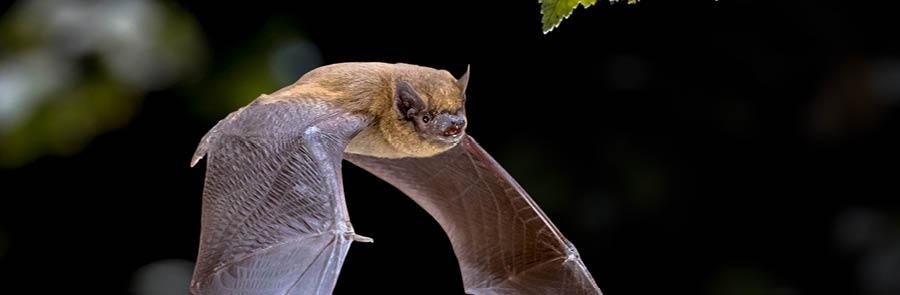
- Fur color can vary from tan to dark brown.
- The muzzle, wing membranes and ears are all black in color.
- Measures between 9 to 14 cm (3.5” to 5.5”) in length.
- Weighs 11 to 25g.
- Wingspan of 32 to 35 cm (12.6” to 13.7”).
- Females are generally larger than males.
Behaviour and Habitat
- The most common species of bat in Saskatoon is the big brown bat (Eptesicus fuscus). This species will often roost in homes and old buildings.
- If bats are disturbed from a roosting site or during the spring and fall migration, it is possible to see them during the day. If you see a bat during the day leave it alone as it will likely leave during the evening.
- Bats hibernate from November to May. The females form maternities or brood colonies. This is where the pups are born.
- The brood colonies can be found in barns, houses, trees and crevices. The colony size can vary from less than ten to several hundred individuals.
- Males will roost singly or in small groups.
- Young bats can fly at approximately 6 weeks.
- Mating occurs in the fall.
Diet
- All bats in Saskatoon feed on insects and it is common to see them foraging at night. Bats eat large quantities of night flying insects including moths, beetles and flies (including mosquitoes).
Co-existing with Bats
- Bats are protected under the Saskatchewan Wildlife Act and cannot be killed or disturbed. The mere presence of bats does not necessitate their removal. If there is little chance for contact with people, there is no need to remove them.
- If you find that you have bats in your home, exclusion may be an option where they pose a physical or health risk to individuals or present a significant impediment to building use. This can involve installing one way doors so that as bats leave they cannot re-enter, however a permit is required from the Ministry of Environment and installation can only occur between May 1 and May 31 and/or between September 1 and September 30. Installing bat houses prior to applying exclusion methods increases the likelihood that bats will change their roost location.
- A bite from any animal can be dangerous and if you are bitten you should consult a physician. Bats can carry rabies and potentially transmit rabies to people or pets. Rabies is a serious neurological disease that is often fatal. It is important to have your pets vaccinated against rabies.