
Encampments
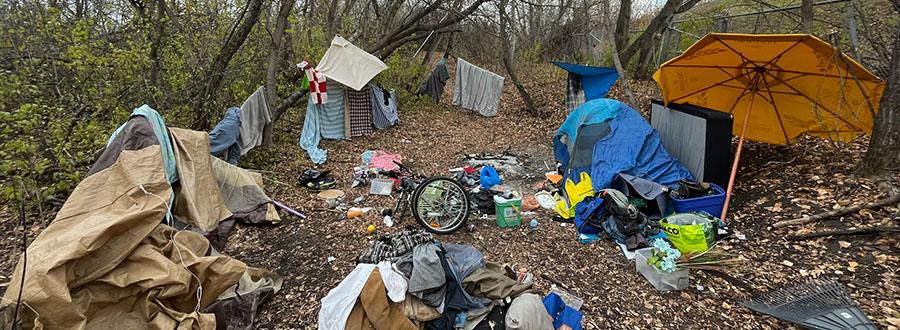
What is an encampment?
An encampment is any area where an individual or a group of people live unhoused together, often in tents or other temporary shelters. Encampments may range from a single structure to multiple structures and may occur on public or private property.
In some circumstances, encampments can pose a level of risk to people staying in the encampment as well as the surrounding community. Risks may include biohazards, needles, garbage, unsafe heating sources, fire and proximity to schools or playgrounds.
Reporting encampments
If you see someone living in unsafe outdoor living conditions, please contact the Service Saskatoon 24hr Customer Care Centre at 306-975-2476 to have your report added to the queue. Current response times for the encampment team is approximately one week.
A coordinated response to encampments
The City’s encampment response prioritizes outreach and connecting people with available supports and services. Each response follows four phases, with outreach offered throughout the process.
- Phase 1: Reporting of Encampments and Site Prioritization
Residents, businesses and City departments can report encampment concerns the Service Saskatoon 24hr Customer Care Centre at 306-975-2476. Fire Bylaw Inspectors assess reported sites to identify health, safety and access risks and determine the appropriate response. - Phase 2: Outreach and support connections
When an encampment is identified, Fire Bylaw Inspectors attend the encampment to offer unhoused individuals connections to available supports and services. - Phase 3: Clean-up
A detailed clean-up schedule is developed that identifies the required City resources and contractor. Before the clean-up begins, any individuals who remain at the encampment are again offered outreach and connections to supports. Once an encampment is confirmed to be inactive, the site is cleaned to remove abandoned structures, unattended belongings and garbage. - Phase 4: Confirmation and next steps
Fire Bylaw Inspectors confirm when the site clean-up is complete. If the site has not been cleaned, they assess the situation and determine the next steps.
Frequently Asked Questions
Why does the City remove encampments?
Encampments are removed because they can create significant health, safety and access risks. The City’s goal is to support the safety and well-being of people staying at the site, neighbouring residents and businesses, and the broader community.
Encampments that remain in place may grow over time and increase risks such as:
- People or belongings blocking emergency exits at neighbouring buildings
- Accumulated human waste, garbage and discarded needles
- Rainwater causing contaminated waste to pool near neighbouring buildings
- Unattended or uncontrolled fires
- Increased drug use and overdose-related calls
- Reported gang activity
- Reported concerns about the exploitation or trafficking of women
How are encampments prioritized?
When an encampment is confirmed Fire bylaw inspectors assess the site to determine the appropriate response and level of priority.
Priority is determined based on the following criteria:
- High
- Indication of a safety concern
- Greater than 10 people with structures/tents
- Near public spaces with high traffic or school/playground
- Hard structure including building construction
- Medium
- Between 2-10 people with structures/tents
- Visible encampment location
- Excessive debris
- Low
- 1 person with a structure/tent
- Vacant site with excessive debris
- When available
- Vacant site with minor debris
- Vacant site with minor debris
What happens when an encampment is removed?
Before an encampment is removed, Fire bylaw inspectors and community partners work with the unhoused individuals to connect them with supports such as access to shelter, housing, food providers, transportation and medical care. Individuals are granted a period of time to gather their belongings and vacate the encampment.
If the encampment is still active at the time the clean-up is scheduled, outreach is offered again by Fire bylaw inspectors, Indigenous Support teams or other community partners before the clean-up begins.
Once an encampment is confirmed to be inactive, the site is cleaned to remove abandoned structures, unattended belongings and garbage.
Fire bylaw inspectors confirm when the cleanup is complete or determine next steps if the site has not been cleaned up.
Does the Saskatoon Police Service ticket people experiencing homelessness?
No. The Saskatoon Police Service does not ticket people simply because they are experiencing homelessness.
To protect the safety of residents and the community, the Saskatoon Police Service enforces the Safe Public Spaces (Street Weapons) Act and the Trespass to Property Act, T-20.2.
What happens if an encampment is on private property?
When an encampment is located on private property, Saskatoon Police Service works with the property owner or authorized representative. Under The Trespass to Property Act, the owner’s permission or direction is required to address trespassing concerns.
Does the Saskatoon Fire Department fine people experiencing homelessness?
No. Saskatoon Fire Department does not fine individuals simply because they are experiencing homelessness. SFD’s role is focused on identifying and addressing fire and life-safety risks, conducting inspections, coordinating high-risk or complex site responses, and supporting connections to outreach services.
How to help
Saskatoon Fire Department works with partnering agencies to provide support to individuals who are unhoused. Residents who wish to donate money or supplies are encouraged to contact the organizations listed below. These organizations can ensure the donations are used where they are needed most.
When evacuating an encampment, individuals are encouraged to take their personal belongings with them; however, items such as tents, blankets and other materials are often left behind. This can increase the amount of material that must be assessed, removed, disposed of and cleaned up.
The City encourages residents to support people experiencing homelessness through established organizations and services that can provide housing, income, health, mental health, addictions and outreach supports.
Material donations can be dropped off at:
Salvation Army
339 Avenue C South
306-244-6280
YWCA
510-25th Street East
306-986-2870
Saskatoon Tribal Council Drop-In Centre
325 Avenue C South
The Mustard Seed
210 Pacific Ave