
Organics Education
Same Waste. Different Place.
The Green Cart didn’t change your waste – just where it goes! You can still cook the same, snack the same and yes – you may even have the same amount of leftovers. Your Green Cart is the place for all food and yard waste. It's a small shift with a big impact. All of those peels, coffee grounds, and wilted leaves can be transformed into rich compost instead of sitting in a landfill.
Since the program started in 2023, Saskatoon residents have diverted at least 20,000 tonnes of organic waste every year. Diverting organics from landfill reduces Greenhouse Gas emissions. In 2025, the Green Cart program avoided 14,137 tonnes of CO2e that would have been released as methane gas if the same materials were landfilled. This is the equivalent of removing 3,142 passenger cars from the roads!
Image:

From dairy to donuts, it all goes in!Your Green Cart isn’t just for yard clippings and veggie scraps, it’s your go-to for all food waste! That means: dairy, meat & bones, breads, noodles & grains and leftovers of any kind. | Image:

Cart filling up too fast?Take that excess yard waste to the City’s Compost Depot for free. We turn it into compost, which is also available for free pick-up (up to 1 cubic yard). For hours and more information, visit saskatoon.ca/compostdepot. |
Image:
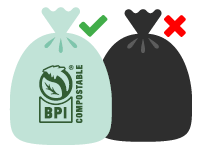
Only BPI-certified compostable bags are accepted.Even if it’s full of food scraps, black plastic bags don’t belong in your Green Cart. Why? They can’t be composted and make it harder to process the good stuff! ✅ Use paper bags, BPI-certified compostable bags or toss food waste in loose. ❌Skip the black garbage bags. They go to landfill, not compost. | Image:
Need to freshen up your cart?
|

Now that you’re a Green Cart expert, test your knowledge and you could win a RYOBI electric leaf blower!
Have more Green Cart questions?
Why do we need a Green Cart program? What are the benefits?
More than half of what we throw in the garbage can go into the green cart. Instead of putting food and yard waste into your black cart, it can be put in the green cart and turned into something useful – compost!
By diverting organic waste away from the landfill, we can delay or even avoid the expense of building a second landfill, reduce greenhouse gas emissions, and reduce environmental pollution.
What goes in your green cart?
ALL food and yard waste is accepted as well as 100% paper products that are food-soiled.
Use the Saskatoon Waste Wizard app to check if an item should be put into your blue, green or black cart, or if it’s appropriate for drop off as hazardous waste.
Do not use plastic bags. Please place your yard and food waste directly into your green cart or use a BPI-certified compostable or 100% paper bin liner.
What materials are not accepted?
- Plastic bags and packaging including compostable, biodegradable or oxo-degradable bags that are NOT BPI certified.
- Compostable and biodegradable plastic items are not accepted, such as cups and cutlery.
- No pet waste, diapers, hygiene products,
- Styrofoam, glass or metal.
- Elm wood
- Any branches more than 60 cm in length or 2 cm in diameter (take to the city compost depot)
Use the Saskatoon Waste Wizard to check if an item should be put into your blue, green or black cart.
Why are only BPI certified compostable bags accepted? Why can't all compostable and biodegradable items be accepted?
There are currently no rules to regulate the use of terms such as “compostable”, “oxo-degradable” or “biodegradable” in the labelling of plastic packaging and single-use items. This means that not all plastic products that are labeled as such have been properly tested to ensure they will completely break down in a commercial compost facility. Incomplete break down will result in small plastic pieces that can contaminate the finished compost.
What if I already compost at home?
It’s great that 23% of people compost at least some of their waste at home, however, it’s not for everyone, so we still need city-wide program to capture the remaining material going to landfill. The city-wide program will still be useful to home composters, as it accepts all the other food and yard waste that cannot be easily composted at home (e.g., meat, dairy, dressed salads) and also provides more capacity for material, which can be especially helpful during the heavy yard waste season.
How is this process different than what happens to food and yard waste at the landfill?
In a landfill, air is removed by compacting and covering materials daily. When food or yard waste breaks down without oxygen, it does not turn into healthy soil but instead pollution, including leachate (garbage juice) that is a risk to water and soil, as well as methane, which is a powerful greenhouse gas that is emitted for decades following the landfilling or organic waste.
In an organics processing facility, the mixing of materials and control of oxygen, moisture and heat levels ensure that materials are fully broken down into a nutrient rich soil instead of harmful pollutants.
How is the composting process different than what happens in my backyard compost or at City’s compost depot?
The green cart materials are sent to an organics processing facility that uses static aerated pile/windrow technology to process the organics into compost. During this process the oxygen, moisture and nutrient levels are carefully controlled so that the temperature of the piles becomes hot enough to safely break down materials like meat, bones and dairy in order to meet a Category A compost standard. This is different than static piles which are used at the current City compost depot and in home composting systems, which do not get hot enough to efficiently and safely break down meat, bones and dairy.