
Fall Webworm
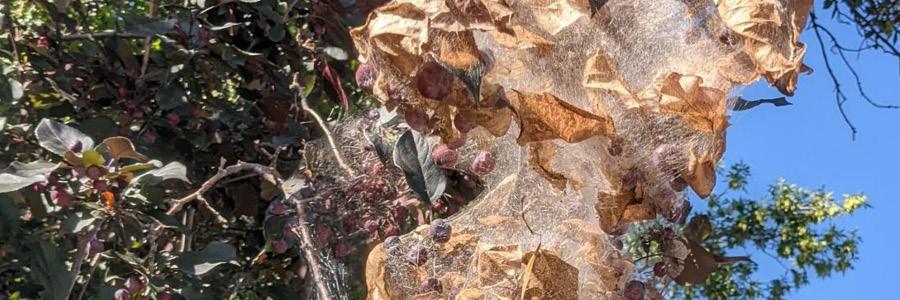
Fall webworm on an ornamental fruiting tree.
Quick Facts
Status: Native, nuisance
Hosts Affected: Affects leaves of fruiting trees, especially crabapple and cherry, as well as poplar, aspen, birch, elm, willow and other deciduous trees.
Appearance: Fully grown caterpillars are about 25 mm long with black heads, yellow brown bodies and long white hairs on black orange bases.
Season: Webworms have one generation per year and feed in late summer to early fall.
What is Fall Webworm?
Fall webworm (Hyphantria cunea) are caterpillars similar to forest tent caterpillars, both of which are native species of moth. Fall webworms have a fuzzy, dark color but do not have white spots on their backs like forest tent caterpillars. Fall webworm have one generation per year and feed at the end of the summer and into early fall. They feed primarily on the leaves of fruiting trees like cherry and crabapple, as well as other trees like poplar, aspen poplar, birch, elm, and willow. The webs typically sit on branches high in the canopy.
What kind of damage is caused by Fall Webworm?
Both fall webworm and forest tent caterpillars create webbing on branches of trees and shrubs. However, fall webworm webs are "messier" and encompass the entire end of a branch and its leaves, whereas forest tent caterpillar webs are situated more in the nodes of branches and have a "tent" appearance.
While the look of fall webworm webs is unsightly, it is rarely damaging to trees, because the growth they feed on is end-of-season growth that will be shed before winter.
How do I control Fall Webworm?
The City of Saskatoon does not have a control program for fall webworm. Consult an arborist or local garden centre for options to control fall webworm if you are concerned about the look of your private tree.