
Badgers
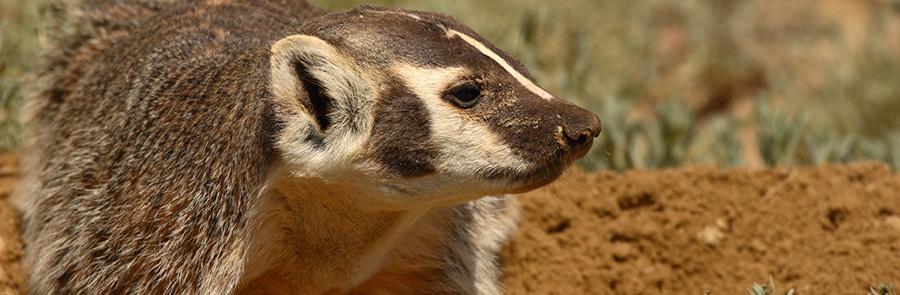
What to do if you have a close encounter with a badger?
- Never approach or feed a badger.
- Identify and maintain escape routes to allow badgers to retreat to their burrows.
- Badgers will act aggressive when they feel threatened. If this occurs calmly leave the area. Badgers will not pursue over great distances.
- If you see a badger in the city, it is most likely just moving through. Take the opportunity to admire it from a safe distance.
- If the badger is injured, trapped or diseased call Urban Biological Services at 306-975-3300.
Appearance
- Stocky body with short powerful legs.
- Elongated face with a distinctive black and white pattern.
- Small round ears.
- Fur is brown, black and white.
- Body length is 60-75 cm (23.6-29.5 in), weight is 7-9 kg (15.5-19.8 lbs).
- Large fore claws, up to 5 cm (2 in) in length.
Behaviour and Habitat
- Use a defense mechanism (defensive bluffing) that may seem like aggression and will snarl, hiss or bare their teeth if provoked. Typically they do this while backing away. Sometimes they move forward in an attempt to chase a threat away from their burrow.
- Use many burrows within their home range. Many of these burrows will be re-used by other animals such as other badgers, foxes and coyotes.
- Habitat is typically open grasslands where badgers can find prey. They prefer prairie regions containing sandy loam soil.
- It is rare for badgers to live within a city. They can be seen moving through urban areas during the fall when they are expanding their territory to find mates and when the young are dispersing in May and June.
- When seen in the city, it is usually in neighbourhoods close to large natural areas.
- Badgers are mostly solitary and nocturnal.
- Despite being nocturnal, badgers can be seen during the day, especially during the spring when females forage and return at night to stay with the young.
- They do not hibernate but become less active during the winter.
Diet
- Badgers are fossorial carnivores, meaning they dig and feed on animals under the ground.
- They feed predominantly on agricultural pests such as ground squirrels, pocket gophers and voles, but will also prey on other small animals, insects (including bees and honeycomb) and some vegetation.