
A Growing City Requires Growing Resources
Over the past 10 years the City of Saskatoon has seen a population growth of 23 per cent. The demands of a growing population has required additional city staff, services and infrastructure.
“With greater investment in resources, the City has been able to service and attract tens of thousands of families who are choosing to move to one of the most successful and prosperous city in western Canada,” says City Manager Murray Totland.
There may be concerns about rising costs over the past decade. Here are some facts to consider:
- To make a reasonable comparison over time, spending amounts should be measured on a per person basis and adjusted for inflation and population growth so that 2006 dollars are the same as what the City would be spending today. Additionally, inflation ought to be calculated for municipal rather than consumer spending.
- Comparing city spending can be difficult to do; each city offers its citizens a diverse basket of services that reflect the needs of the community and cities may fund those services different ways.
- The best way to make an apples to apples comparison with other cities is to look only at what tax dollars each one spends on operations.
“With these factors in mind and based on our Civic Services Survey, Saskatoon’s spending has been careful yet responsive to what citizens want,” Totland says.
Here are some key measures used by economists to demonstrate spending trends:
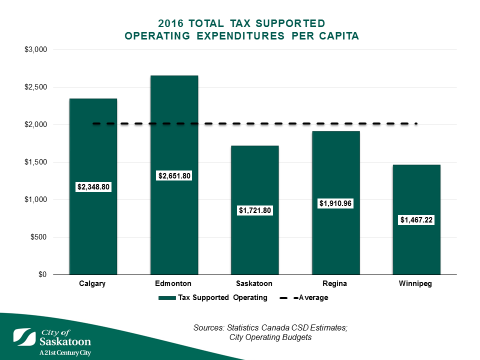
In light of growth, Saskatoon had the second lowest tax supported operating expenses among prairie cities after Winnipeg.
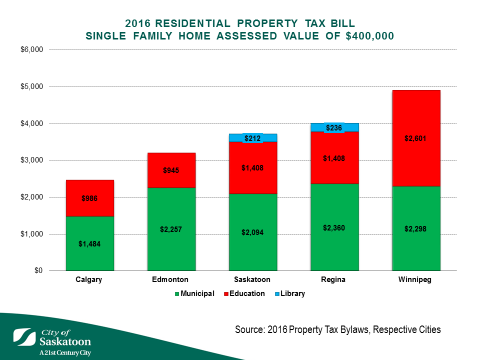
Another way to measure the expenditure burden on residents is to look at the tax burden that is required to help fund the budget for a city. For example, considering the total residential property taxes that would be levied in each city, on a property with an assessed value of $400,000, Saskatoon’s municipal property taxes are the second lowest after Calgary.
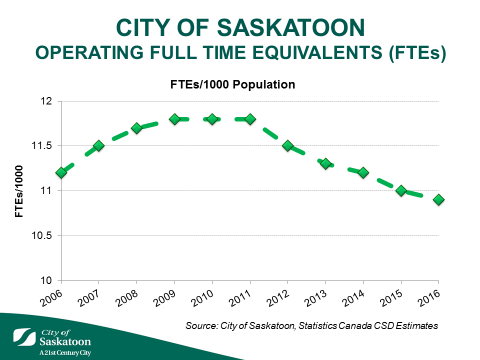
Another important measure of how much a City spends is the number of full time jobs for its operations per 1000 population. As we see, the City’s employment numbers have been declining as a share of the population since 2011.
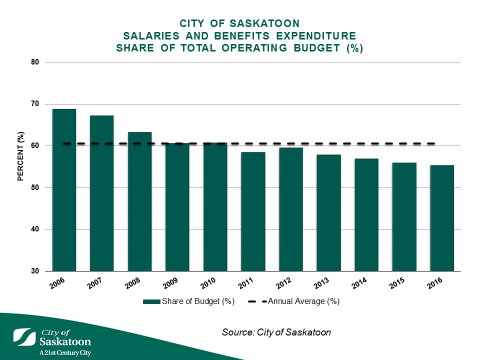
In terms of what is spent on those employees we see a similar trend for the percentage share of salaries and benefits for the City’s operating budget. In 2006, this was 60.8 percent of the City’s operating budget, while in 2016 it is 55.4 percent.
Finally as the following graph indicates, over this same period of time, Average Saskatchewan weekly earnings have grown by between 30 and nearly 50 percent, well beyond a consumer or municipal price index inflationary adjustment.
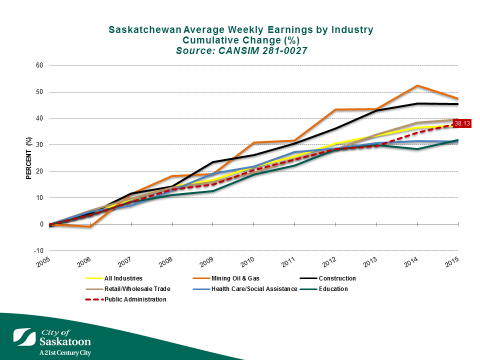
In order for the City to offer citizens the services they want, salaries have to stay competitive with the demands of the labour market.
“Overall, while basic calculations of population and budget growth may reveal large percentage spending increases, there are many more factors to consider,” Totland says. “When an appropriate economic analysis is applied, it demonstrates Saskatoon’s spending is careful, cautious and again, measured to what citizens want in a 21st Century City.”