
News Releases
Saskatoon Fire - News Releases
2025 Point-in-Time Count reveals rising homelessness trend
November 25, 2025 - 9:02am
- Unsheltered – 725
- Encampments – 151
- Emergency Shelters – 327
- Transitional Homes – 444
- Systems – 47
- Hidden Homelessness – 237
- TOTAL* – 1931
The most recent one-day count of people experiencing homelessness in Saskatoon found there are more individuals without stable housing in the city tallied than ever before.
The City of Saskatoon, in partnership with Saskatoon Housing Initiatives Partnership (SHIP), conducted Saskatoon’s fifth Point-in-Time (PiT) Count on October 16, 2025.
The count identified 1,931 individuals experiencing homelessness in the city. This figure represents an increase of 432 individuals experiencing homelessness over the 2024 count.
The PiT Count provides a snapshot of the minimum number of individuals experiencing homelessness, both sheltered and unsheltered, across Saskatoon. This year’s count focused on enumerating individuals rather than conducting full surveys.
“This count represents the minimum number of individuals currently experiencing homelessness in Saskatoon, both sheltered and unsheltered,” says Lesley Anderson, Director of Planning and Development. “Beyond providing numbers at a single point in time, the data and demographic insights collected are critical for understanding the complex challenges faced by those affected.”
Anderson says this information will guide the development of more responsive, community-driven solutions that address immediate needs while supporting long-term strategies.
“The findings also reveal a concerning upward trend in homelessness, reinforcing the need for continuous monitoring,” Anderson says. “Tracking these changes over time will help us measure progress, adapt interventions, and ensure that resources are directed where they can have the greatest impact.”
More than 250 volunteers were dispersed across the community to count individuals staying in emergency shelters, transitional housing and unsheltered locations such as encampments. The data collected through their efforts will help inform local strategies and support services aimed at addressing homelessness in Saskatoon.
“SHIP is very thankful to all the volunteers and agencies that helped out with the PiT count. While this year’s PiT count was well-organized and successful we are always mindful that the numbers reflect real people who are experiencing poverty, mental health issues, addictions, family violence and other social challenges,” says Robert LaFontaine, Executive Director of the Saskatoon Housing Initiatives Partnership.
“It is now our work as a community to provide opportunities for those people and families to change their circumstances. We thank the City of Saskatoon for coordinating the PIT count and we hope to continue our partnership.”
A comprehensive report with data collected from the 2025 PiT Count will be released in early 2026.
The PiT Count is funded by the Government of Canada through Reaching Home: Canada’s Homelessness Strategy.
For additional information about the PiT Count, visit saskatoon.ca/pit.
*Key Terms
Unsheltered Homelessness − Without any form of shelter and residing in public places (i.e. streets, park, vacant buildings) or in areas not fit for habitation (i.e. cars)
Encampments – Outdoor locations with a group of tents, makeshift shelters or other long-term outdoor settlements, where two or more individuals are staying.
Emergency Shelters – Individuals residing in emergency shelters. It may include people who receive hotel/motel vouchers in lieu of emergency shelter. It does not include people who have security of tenure or who are in social or supported/subsidized housing.
Transitional Housing − Intended to offer a supportive living environment for its residents, including offering them the experience, tools, knowledge, and opportunities for social and skill development to become more independent and transition from homelessness to secure housing. It is considered an intermediate step between emergency shelter and supportive or independent housing, and has limits on how long an individual or family can stay.
Systems − Refers to people experiencing homelessness who spend the night in a health or correctional facility, such as: an urgent care facility; emergency department; hospital inpatient ward; detox, treatment or rehabilitation centre; correctional facility; or police holding cell.
Hidden Homelessness − Individuals experiencing hidden homelessness include those living temporarily with others without guaranteed residency (i.e., couch surfing) and staying in short-term rentals without secure tenure (i.e., self-funded motel/hotel).
UPDATED RELEASE: Strong growth boosts 2026 Budget revenues
November 19, 2025 - 3:52pm
- By email using the online form
- By mail or in person:
Office of the City Clerk
222 – 3rd Avenue North
Saskatoon, SK S7K 0J5
Please note: This New Release has been re-issued to provide an updated Budget Agenda link to correct a typographical error in the Saskatoon Police budget report. The Saskatoon Police Budget capital ask was incorrectly stated as $4,607,000,000; the correct figure is $4,607,000.
City Administration has finalized the 2026 assessment growth revenue at $3.9 million, which is $2.5 million higher than the preliminary estimate of $1.4 million released earlier this month.
“This higher than anticipated revenue is very good news for the City and taxpayers; it helps to partially offset the added costs of responding to increased fire and police calls, maintaining more kilometers of roads and more hectares of park space that come with a growing city,” says Chief Financial Officer, Clae Hack. “It’s a positive indicator that reflects the continued strength and resilience of our local economy.”
Assessment growth refers to new property tax revenue generated from construction, major renovations and property improvements across the city. This growth expands the tax base, allowing the cost of City services and capital projects to be shared among more properties. As a result, the preliminary 2026/2027 budgetary tax increase for existing property owners in Saskatoon will be lower than Administration previously projected.
The stronger-than-expected assessment revenue is a positive development that reflects ongoing confidence in the Saskatoon economy. It will give City Council more financial capacity as it prepares for the 2026/2027 Budget deliberations set for November 25–27, 2025.
The 2026/2027 Budget agenda is now available online at saskatoon.ca/meetings.
The agenda includes the Administration’s report with more than 100 budget scenarios for City Council to review; all are aimed at lowering property tax rates in 2026 and 2027. It also features reports from the City’s Controlled Corporations and Statutory Boards, along with general reports and operating and capital options. Agenda items may change.
How to participate in the 2026/2027 Budget with City Council
Members of the public may submit comments or request to make a five-minute presentation, either in person or remotely, during City Council’s 2026/2027 Budget deliberations.
Deadline: Submissions will be received until 5:00 p.m., Monday, November 24, and will appear on the revised agenda.
Ways to participate:
For questions about the 2026/2027 Budget participation process, contact the City Clerk’s Office at 306-975-3240.
City Council’s 2026/2027 Budget deliberations will be live streamed for all residents at saskatoon.ca/livestream. Meetings will begin at 9:30 a.m. each day.
Visit saskatoon.ca/budget for additional budget-related information.
City green network project honoured at 2025 Premier’s Awards of Excellence in Design Gala
November 18, 2025 - 10:00am
- Food Forests – inviting spaces planted with fruit-bearing trees, shrubs and perennials to provide edible landscapes and increase canopy cover.
- Water Conservation Measures – adaptive irrigation systems and naturalized plantings to reduce water use and operational costs.
- Park Upgrades – new pathways, benches, bike racks, playground equipment (Boughton Park) and educational signage to improve accessibility and amenities.
The City of Saskatoon is proud to announce that its green network project, Nourishing Community: Leif Erickson and Boughton Park Enhancements, received a Certificate of Merit for Landscape Architecture at the Design Council of Saskatchewan’s 2025 Premier’s Awards of Excellence in Design Gala, held on Friday, November 7, 2025, in Saskatoon.
Funded in part by the Government of Canada’s Natural Infrastructure Fund, this innovative project demonstrates how thoughtful design can strengthen communities, improve sustainability and enhance public spaces.
Constructed in 2025, the enhancements at Leif Erickson and Boughton Parks included:
By coordinating these complementary activities, the City reduced construction impacts, saved time and money and optimized external funding. The integrated approach also delivers multiple co-benefits, including addressing food insecurity, improving green space quality, reducing greenhouse gas emissions and supporting canopy cover targets.
“This project reflects our commitment to creating resilient, inclusive spaces that meet community needs,” says Jeanna South, Director of Sustainability. “We’re honoured to be recognized among Saskatchewan’s design leaders.”
For more information about the Premier’s Awards of Excellence in Design, visit: designcouncil.sk.ca/premiers-awards
For more information on the Leif Erickson and Boughton Park upgrade projects, visit:
saskatoon.ca/engage/boughton-park-upgrade
saskatoon.ca/engage/leif-erickson-park-upgrade
For more information on Saskatoon’s Natural Infrastructure Fund: Green Network Project, visit:
Investing in growth, delivering on service priorities: Preliminary 2026/2027 Multi-Year Business Plan & Budget
November 6, 2025 - 4:00pm
- Transportation Infrastructure – $84.4M (2026) and $89.4M (2027) to resurface roadways, improve network reliability and maintain winter snow clearing standards across a larger service area.
- Transit Development – $52.7M in capital investment to expand the bus fleet and advance LINK construction, and improve transit connections between growing neighborhoods and employment, healthcare and services.
- Public Safety – Additional firefighters for Fire Hall No. 11 and enhanced Fire Apparatus Reserve funding to reduce emergency response times as the city expands.
- Operations & Community Services – Sustained funding for recreation facilities, community programs, and civic operations maintains access to services residents rely on daily.
After two consecutive years of record population growth that added 25,000 residents to Saskatoon, the City's Preliminary 2026/2027 Budget focuses on core services and infrastructure investments that keep pace with demand: repaving aging roads, expanding transit service and strengthening emergency response capacity.
The Preliminary 2026/2027 Multi-Year Business Plan and Budget and the Preliminary 2026/2027 Capital Project Budget prepared by City Administration, proposes strategic investments to enhance service delivery and support for a growing city.
Proposed Strategic Investment Highlights:
"These investments address the infrastructure gap that rapid growth creates," says Chief Financial Officer, Clae Hack.
“From 2022 to 2024, our city added 25,000 people — more than the populations of Yorkton and Humboldt combined — and we expect another 9,000 new residents in 2025. With that kind of growth, we need more buses, more road maintenance, and more fire halls to maintain our service levels. Administration’s proposed budget invests in the infrastructure and services needed to support our growing population.”
Hack notes that while inflation and expanding service demands place pressure on the operating budget, Saskatoon still maintains one of the lowest municipal property tax environments among major western Canadian cities—supported by the City's ‘AAA/Stable’ credit rating, which has been held for 23 consecutive years.
"Our credit rating reflects disciplined financial management that keeps the City’s borrowing costs low," Hack adds. "That means valued taxpayer dollars stretch further on capital projects."
In response to the Governance & Priorities Committee’s June 2025 direction, Administration developed multiple budget scenarios that demonstrate potential reductions to the preliminary municipal property tax rate, with corresponding service adjustments. These scenarios will provide City Council with clear options during its deliberations.
The Preliminary 2026/2027 Budget represents Administration's assessment of resources required to maintain service delivery and support for Council's strategic priorities. Final budget decisions will be made by City Council during deliberations scheduled for November 25–27, 2025.
Council’s 2026/2027 Budget deliberations will be live streamed.
Visit saskatoon.ca/budget for more information.
Strong Satisfaction with City Services, Homelessness and Safety Top Issues: Civic Surveys
November 6, 2025 - 7:00am
From neighbourhood parks to reliable services, Saskatoon residents say they appreciate the quality of life their city offers. Results from the City’s 2025 Civic Services Surveys show most residents continue to feel positive about life in Saskatoon while identifying key areas for improvement.
The Governance and Priorities Committee of City Council will receive a report detailing survey findings at its November 12 meeting.
“The surveys continue to confirm that residents value the services the City provides and feel a strong connection to their community,” says Carla Blumers, Director of Communications and Public Engagement. “At the same time, the results highlight areas where residents want to see more action, particularly around housing, homelessness and public safety.”
Eighty-two per cent of respondents say they are satisfied with life in Saskatoon, consistent with 2024. Nearly seven in 10 rate the city’s quality of life as good or very good. and more than half say things have improved or stayed the same over the past three years.
When asked about the most important issues facing Saskatoon, survey respondents say homelessness, crime and housing are priority areas. Homelessness is the top concern for 35 per cent of respondents, followed by crime and public safety at 21 per cent and housing at 11 per cent.
The majority of respondents – 80 per cent – say they are satisfied with the quality of services provided by the City. This is an increase of five percentage points from 2024. And 79 per cent say they receive good or very good value from the services provided. The survey further explored how respondents evaluated 31 City services. Top-rated City services include drinking water quality, fire protection, electrical reliability, water main break repairs and garbage collection.
Policing, snow and ice road maintenance and traffic management were identified as top priorities for improvement. This marks a shift from 2024, when only police services were highlighted as a key area for improvement.
“The 2025 results provide a strong foundation for future planning,” Blumers says. “The City will use this feedback to inform decisions on strategic priorities, budgeting and service delivery, and to identify opportunities for continuous improvement.”
Survey results are available at saskatoon.ca/civic-services-surveys.
UPDATE: Improved rider interactions highlight success of Transit safety measures: Committee Report
November 4, 2025 - 11:34am
Saskatoon Transit is issuing an update to this morning’s media release regarding the success of recent safety measures and improved rider interactions.
A technical issue was identified in the distributed version of the release, resulting in three tables being omitted from the mailed version. These tables contain key data referenced in the report.
The complete version of the release, including the three missing table graphics, is available online at: saskatoon.ca/news-releases.
Improved rider interactions highlight success of Transit safety measures: Committee Report
November 4, 2025 - 7:00am
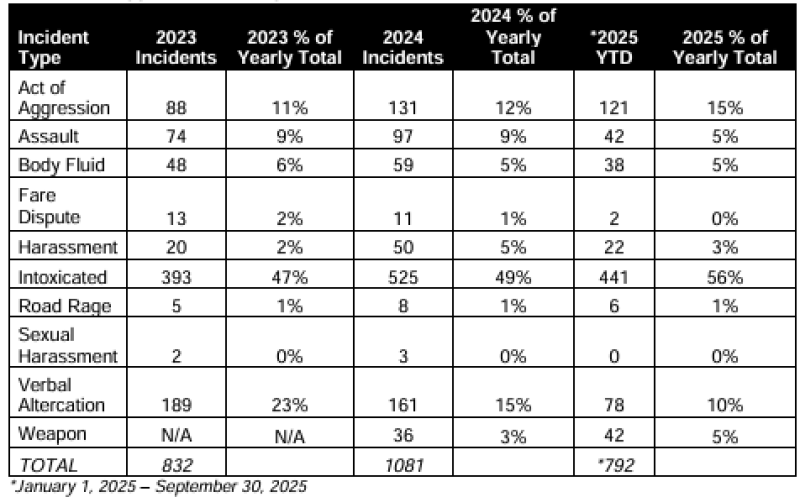
- Act of Aggression – an action made with the intent to cause harm or intimidate.
- Assault – physical contact made with an Operator or person
- Body Fluid – blood, spit, urine, or feces
- Fare Dispute – a passenger refusing to pay fare after being advised by the Operator
- Harassment – a continued, and unwelcome behaviour directed towards an Operator
- Intoxicated – a passenger suspected of being under the influence of alcohol or drugs impacting passenger or operators feeling of safety
- Road Rage – exchanges by motorists directed towards the Operator
- Sexual Harassment – comments or conduct of a sexual nature
- Verbal Altercation – exchange between passenger and Operator involving shouting and/or swearing
- Weapon – Sharp or bladed objects, blunt objects, non-lethal objects that can cause harm.
Negative interactions on Saskatoon Transit buses have been trending down significantly since June of this year, a report to the Standing Policy Committee on Transportation shows.
The Committee is set to receive this information at its regular meeting today.
“Saskatoon Transit implemented the Frontline Employee Safety Plan in June of 2024 and we see its desired effect,” says Mike Moellenbeck, Director of Saskatoon Transit. “We have fostered a culture of safety at Transit and since implementing all the elements of the plan we have seen a significant downward trend in the number of negative interactions reported on and around Saskatoon Transit facilities.”
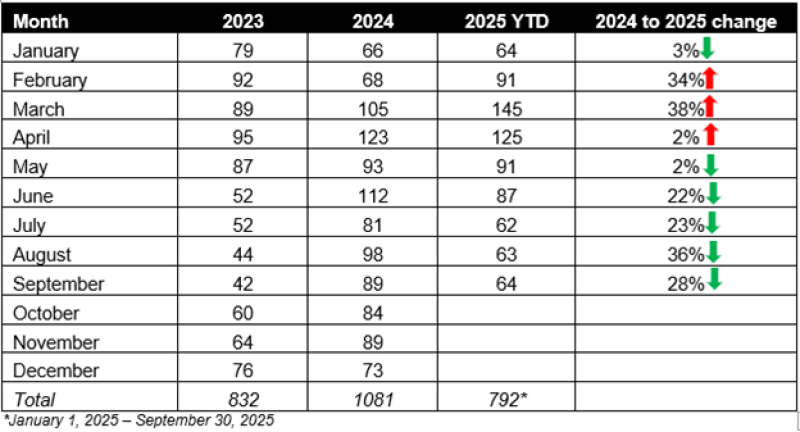
A negative interaction is defined as an incident that involves up to three of the following:
The most common incidents continue to be related to social disorder issues such as intoxication (56%) and aggressive acts (15%) making up 71 per cent of all 2025 incidents.
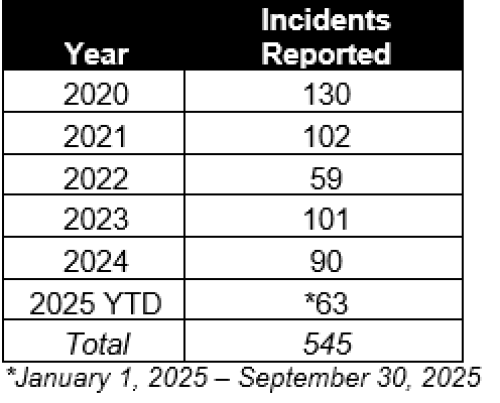
Moellenbeck says negative interactions involving an Operator have declined since 2023 and are trending to be lower in 2025.
The report points to an innovative interagency cooperation between Saskatoon Transit and key organizations such as the Saskatoon Fire Department, Saskatoon Police Service, and the Corps. Of Commissionaires, among others, that provide necessary safety measures.
Of note, Fire Community Support workers (FCS), provide a visible uniformed presence at terminals and ride an average of 220 buses per month to support Transit and the Business Improvement Districts.
“The program’s effectiveness is demonstrated by its supportive, non-enforcement approach, with the objective of de-escalating situations and providing outreach programs to those in need,” Moellenbeck says.
Transit has also introduced new training for its frontline employees on customer service, situational awareness and de-escalation. This training ensures employees are supported in their interactions with different types of customers.
Favourably, most incidents are handled by Transit and FCS; only about 11 per cent require Police intervention.
“We’re encouraged with the results so far,” Moellenbeck says. “The investments City Council has made on public safety are making Transit a more safe and comfortable way to get around.”
Broadway Bridge to reopen Saturday evening
October 30, 2025 - 3:15pm
Saskatoon’s Broadway Bridge is set to reopen on the evening of Saturday, November 1 following a major rehabilitation project. Barring any unforeseen circumstances, drivers, cyclists and pedestrians will once again have full access to the bridge.
“This was a major project that included deck repairs, improvements to the multi-use pathways, new asphalt, new waterproofing, new traffic barriers, arch and railing improvements and the removal of old and abandoned utilities underneath the bridge,” says Terry Schmidt, General Manager of Transportation and Construction.
One of the most significant changes has been the reconfiguration of the 4th Avenue and 19th Street intersection. To improve traffic safety and accommodate pedestrian movement, it is now a 'T' intersection.
“This intersection redesign supports future Saskatoon Transit Link plans and makes it easier for buses to navigate between Broadway Avenue and 19th Street,” Schmidt says. “The Broadway Bridge is a vital connection for our community, and these upgrades will serve all residents for decades to come.”
While the bridge and Spadina Crescent are reopening to vehicles and pedestrians, repairs will continue underneath the bridge. This work is not expected to impact traffic.
Saskatoon Transit will resume Route 8 service along Broadway Avenue once the bridge reopens. Service to temporary stops on Victoria Avenue and travel along the Traffic Bridge will end when regular service on Broadway resumes. Trip planning, service alerts and real-time bus information are available on third-party apps like Transit and Google Maps Transit on desktop.
Council defers decision on proposed Event Centre and Convention Centre operator Agreement Framework
October 29, 2025 - 2:10pm
City Council has, at its October 29 Regular Business Meeting, deferred a decision on a proposed private partner Agreement Framework with OVG360 (OVG) which would have begun to create a third-party operating management structure for the Downtown District Event Centre and Convention Centre.
Council voted unanimously to defer a discussion on the proposed framework until the first quarter of 2026 to further process the information, consider negotiated points and have an opportunity to discuss with impacted organizations.
The proposed agreement framework presented to Council set out $15 million in up-front capital plus a projected $235 million in forecasted operating revenue sharing over the full potential 30-year term, in contrast with the previous agreement which estimated a projected $170 million (combined capital and operating revenue) over 25 years.
The proposed agreement would reduce financial risk for the City: if there are Event Centre losses, those would be absorbed by OVG. The proposed agreement also addresses community benefits including economic opportunities for traditionally marginalized groups, employment that will work with existing employees and unions, and benefits for community non-profit events.
For more information on OVG360 please visit oakviewgroup.com/ovg360/.
For more information on the Downtown Event and Entertainment District, including background information and previous Council decisions, please visit saskatoon.ca/eventdistrict.
New transitional housing opens doors for support, safety and stability
October 24, 2025 - 10:30am
- Aggie’s House will operate as short term housing, offering immediate refuge, wraparound supports and access to meals through a shared kitchen.
- Shirley’s House will provide longer-term transitional housing where residents will have private kitchens, purchase their own groceries and pay rent as they prepare to reintegrate into the broader community.
- $7.6 million from Canada Mortgage and Housing Corporation
- A subsidy from Indigenous Services Canada
- $540,000 from Saskatchewan Housing Corporation
- $540,000 from the City of Saskatoon, along with a permit rebate and a five-year incremental abatement
- $1.4 million from the National Indigenous Collaborative Housing Incorporated
The City of Saskatoon, in collaboration with the governments of Canada and Saskatchewan, Indigenous Services Canada (ISC), and the National Indigenous Collaborative Housing Incorporated (NICHI), is proud to announce the official opening of Aggie’s and Shirley’s House, a transformative new transitional housing development designed to provide safe, culturally appropriate support for Indigenous women, children and 2SLGBTQI+ individuals fleeing domestic violence.
Located in the Kensington neighbourhood, this thoughtfully designed development will be operated by Central Urban Métis Federation Inc. (CUMFI) and features two distinct wings with a total of 20 fully furnished units:
This vital project was made possible through the generous contributions of multiple funding partners, including:
In addition to safe and stable housing, residents will have access to trauma-informed counselling and therapeutic supports provided by Elders, responding to a growing need for culturally grounded healing services in Saskatoon.
Aggie’s and Shirley’s House represents a significant step forward in addressing the urgent need for transitional housing and healing spaces for those in the Indigenous community. This project embodies a unified commitment to fostering reconciliation, cultivating safety and empowering individuals through stable housing.
QUOTES
"The City of Saskatoon is proud to contribute to the development of Aggie’s and Shirley’s House. Our support reflects our commitment to collaborative, community-driven solutions to urgent housing needs. This project is a powerful example of what can be achieved when all levels of government, Indigenous organizations, and community partners come together. We are deeply grateful to everyone involved in making this vision a reality and look forward to the positive impact these homes will have on the lives of those who need them most." - Mayor Cynthia Block
“In partnership with Indigenous-led organizations and all levels of government, we’re proud to help bring Aggie and Shirley’s Shelter to life—a vital refuge for Saskatoon’s most vulnerable. These emergency and transitional housing units will offer Indigenous women, children, and 2SLGBTQI+ community members a safe place to heal, rebuild, and thrive—supported by services rooted in culture, dignity, and care.” – The Honourable Mandy Gull-Masty, Minister of Indigenous Services Canada
“Far too many vulnerable people fleeing violence struggle to find safe, stable housing. That’s why the work CUMFI is doing here in Saskatoon is so important — and why our federal government was proud to partner with them in this work. Together with Indigenous partners, non-profits, and all levels of government, we’re helping ensure that safe, affordable homes are within reach for everyone who needs them.” – The Honourable Buckley Belanger, Secretary of State (Rural Development) and Member of Parliament for Desnethé —Missinippi—Churchill River
“Transitional housing is a critical component in supporting those who need security and stability to build a brighter future. Aggie’s and Shirley’s House expands access to short-term and transitional housing in Saskatoon, giving individuals and families a safe, secure place to heal and rebuild their lives”. – The Honourable Terry Jenson, Minister of Social Services and Minister Responsible for Saskatchewan Housing Corporation (SHC)
NICHI is proud to support the Central Urban Metis Federation (CUMFI) Grand Opening with $1.46 million in funding toward a transformative project for 20 units of 1-3 bedrooms. Aggie's and Shirley's House will provide critical shelter and transitional housing for Indigenous women and 2SLGBTQQIA+ individuals and their children fleeing domestic violence. This initiative reflects our commitment under the Urban, Rural and Northern housing strategy to safe, culturally grounded spaces that foster healing and resilience." – John Gordon, CEO National Indigenous Collaborative Housing Incorporated (NICHI)
“CUMFI’s vision for the emergency and second stage intimate partner violence homes for Indigenous women and Two-Spirit has always been that it will be a safe welcoming environment at a time when no place seems safe.” - Shirley Isbister, Central Urban Métis Federation Inc. (CUMFI) President