
News Releases
Saskatoon Fire - News Releases
Important changes to the City’s new Waste Bylaw from October 31, 2022
November 4, 2022 - 9:45am
The City of Saskatoon has a new Waste bylaw. On Monday, October 31, City Council approved Bylaw No. 9844, The Waste Bylaw, 2022, which now has replaced the previous Bylaw No. 8310, The Waste Bylaw, 2004.
“In anticipation of new waste diversion programs beginning in 2023, the City decided to update the structure and content of our Waste Bylaw, which had been first approved 18 years ago and had undergone many amendments,” says Brendan Lemke, Director of Water and Waste Operations. “The new bylaw prepares us for the curbside organics program and Recovery Park a diversion depot co-located at the landfill, which are both set to launch in 2023.”
The changes in the new bylaw include:
• New requirements to place recyclable and organic materials into the appropriate collection containers
• Guidelines for home composting systems, including requiring that they be located within property lines
• Standards for new multi-unit residential buildings to ensure City waste collection can be completed
• New standards for waste containers used for construction activities
• Restrictions on the composting of elm wood waste in any City program to help protect Saskatoon’s urban forest from Dutch elm disease.
“The Waste Bylaw keeps our community safe and our environment clean by instructing our community on how to properly store, sort, divert, and dispose of solid waste,” says Lemke. “The City will continue to take an education-first approach with our Waste bylaw to help make sure residents and businesses are aware of what is required and make a change before following through on enforcement.”
For more information on the City’s Waste Bylaw, visit www.saskatoon.ca/content/bylaw-9844-waste-bylaw-2022.
Saskatoon residents concerned about financial impacts of climate change, environmental awareness survey shows
November 4, 2022 - 8:30am
A survey conducted on behalf of the City of Saskatoon by Forum Research between February and April 2022 indicates that significantly more residents claim climate change is an important environmental challenge that must be addressed—an increase of 41% from five years ago.
When asked to identify the main environmental issues facing the City, residents are most likely to focus on climate change related concerns such as extreme weather and global warming, as well as waste reduction issues like waste management and city cleanliness. The survey showed that three in five respondents raised these issues, with 50% of respondents saying they believe climate change is negatively affecting Saskatoon today.
The survey also showed residents are most concerned with how climate-related issues will affect them financially, with more than 80% of respondents saying they are very or somewhat concerned about how climate change will affect the cost of food, energy, public services, and insurance.
“The good news is, the City has been working on greenhouse gas emission reductions and waste diversion initiatives for some time now,” says Jeanna South, Director of Sustainability. “The City has also been working on several implementation plans related to waste reduction, aggressive emission reduction targets, climate action and resilience. We are focused on finding ways to make our operations more sustainable and environmentally friendly, with a focus on high-impact activities.”
The City’s Climate Action Plan: Progress Report 2021 will be presented to the Standing Policy Committee on Environment, Utilities and Corporate Services on November 7. The report tallies the progress that has been made on the Climate Action Plan, which includes The Low Emissions Community Plan and the Corporate Climate Adaptation Strategy.
The City has committed to reducing emissions by 80% below the 2014 baseline by 2050 for both the community and the City’s own operations and has set an interim target of 15% reduction for the community and 40% reduction for the City by 2023.
2022 Environmental Awareness: Resident Survey can be found at Saskatoon.ca/climate
Climate Action Plan: Progress Report 2021 can be found at Saskatoon.ca/climate
Climate Action Plan Progress Report shows Saskatoon's per capita emissions have decreased by 20% since 2014
October 28, 2022 - 10:00am
A report headed to the Standing Policy Committee on Environment, Utilities and Corporate Services outlines progress that the City of Saskatoon (City) has made toward greater sustainability and lower greenhouse gas (GHG) emissions. The Climate Action Plan: Progress Report 2021 (2021 Progress Report) will be presented to the committee on November 7. The report tallies the progress that has been made on the Climate Action Plan, which includes The Low Emissions Community Plan (LEC Plan) and the Corporate Climate Adaptation Strategy.
The City has committed to reducing emissions by 80% below the 2014 baseline by 2050 for both the community and the City’s own operations and has set an interim target of 15% reduction for the community and 40% reduction for the City by 2023.
In 2021, Saskatoon emitted 3,509,600 tonnes of CO2e, which is a 9% reduction from the 2014 baseline of 3,852,200. Saskatoon’s per capita emissions decreased by 20% since 2014 at 12.4 tonnes of CO2e per person (down from 15.6 per person in 2014). Reductions were seen in all sectors except Agriculture. Emissions from the City’s own operations decreased by 3% (from 225,000 in 2014 to 217,800 in 2021) with most reductions seen in the Buildings and Streetlighting sectors.
“The good news is, our emissions are trending downwards,” says Director of Sustainability Jeanna South. “Our goals are aggressive because they have to be. Climate change is happening, and we need to adapt our actions and mitigate potential damage quickly. We no longer have the option of taking our time. Our actions at the City of Saskatoon set the tone for the rest of the community, and we have put careful thought into our goals and have detailed plans for how to achieve each one of them.”
The City has progressed 26 of the 40 Actions outlined in the LEC Plan and 18 of the 30 Actions in the Corporate Climate Adaptation Strategy. One area of progress that is also a focus of the November 7 Committee meeting is energy generation, with 10/12 actions on track. Alternative Currents is an implementation plan for Saskatoon’s energy transition and will also be discussed at the Committee meeting.
Alternative Currents provides an implementation plan that is founded in the LEC Plan which establishes the City’s framework for becoming completely powered by renewable and/or low-emissions energy, including investments in local energy generation facilities (solar photovoltaics, hydropower, and district energy) through 12 actions. Alternative Currents provides a phased implementation plan for progressing these actions over the next 10 years.
“Fossil fuels are increasingly costly, and we cannot control for that. What we can do is look at ways to reduce our reliance on fossil fuels so that we insulate the City budget and the mill rate from this variable to some degree,” comments Jeanna South.
Specific initiatives from Alternative Currents that help progress corporate climate action targets include the installation of solar PV on municipal rooftops and land, the expansion of landfill gas capture from the Saskatoon Landfill, renewable energy procurement, residential rebates and reviewing solar PV access and orientation to encourage resident self-generation. Each action in the implementation plan will be brought forward separately for funding approval by Mayor and Council before further work progresses.
Reports available:
The City’s Climate Action Plan: Progress Report 2021 can be found at Saskatoon.ca/climatechange
Alternative Currents: An Implementation Plan for Saskatoon’s Renewable and Low-Emission Energy Transition can be found at Saskatoon.ca/renewablenergy
City launches Veteran Parking Pilot Project
October 31, 2022 - 11:30am
From November 1, 2022, through October 31, 2023, the City will be piloting a new parking program for Veterans that will allow Saskatchewan Veterans with registered Veteran plates issued by SGI to park free of charge in Saskatoon's pay parking zones within the posted time limits.
”Through community engagement and research, it was found that amendments to the existing program could be made to provide a simplified and improved process for veteran parking similar to other Saskatchewan cities that are offering Veteran parking programs” says Matt Grazier, Director of Community Standards with the City of Saskatoon, “This is a pilot program that we are pleased to offer as a small ‘thank you’ to Saskatchewan Veterans for their service to our city, province, and country.”
This initiative is part of a one-year pilot project exploring the impacts of this program on parking supply and turnover in pay parking zones. At the end of the pilot project, City Administration and City Council will review the impacts and decide whether to continue the program beyond the pilot’s end date.
For more information, visit saskatoon.ca/veteranparking.
Saskatoon road, bridge and water main construction projects wrap up for 2022
October 25, 2022 - 7:30am
Another construction season has drawn to a close and with City Council’s annual $64 million investment, City and contractor crews have again improved several kilometres of roadways and sidewalks and replaced water mains and service connections in historic neighbourhoods.
A major rehabilitation project on Circle Drive North involved rebuilding severely deteriorated curbs and medians between Alberta Avenue and Millar Avenue. The east bound lanes were also repaved. It’s just one of many high traffic areas of Saskatoon to receive major improvements this year.
“We’ll return in the spring of 2023 to resurface the westbound lanes,” says General Manager of Transportation and Construction, Terry Schmidt. “This was our plan from the beginning of the construction season because we wanted to avoid major traffic tie ups and restrictions to business access points on this section of Circle Drive over such an extended continuous timeframe.”
Other major projects included intersection resurfacing and adding a right-hand turning lane on Warman Road southbound onto 33rd Street, rehabilitating the Spadina Crescent Bridge, repaving the Attridge Drive overpass at Circle Drive, and the continuation of water main replacement projects in several neighbourhoods. Schmidt says approximately 24 kilometres of water mains and sanitary sewer mains were replaced or rehabilitated in 2022, which is about the distance from Downtown Saskatoon to Warman.
“We truly appreciate the patience of residents in neighbourhoods where water main replacements took place,” Schmidt says. “In some areas, we ran into unexpected circumstances which caused delays. The water main replacement program will continue next year.
Also in 2023, construction will have an impact to commuters using the nearly 40-year-old Circle Drive North Bridge. One side will accommodate two-way traffic while the other side is rehabilitated. The pedestrian bridge underneath will not be affected. Several more construction projects will be planned over the upcoming winter months.
Sidewalks are also a major focus every summer with City departments working collaboratively to make significant improvements to the management and execution of the Sidewalk Repair Program. In 2022, crews repaired or rehabilitated approximately 59 kilometers of sidewalks and curbs.
For more 2022 construction highlights, please visit saskatoon.ca/construction.
City launches recycling education campaign for businesses and organizations in Saskatoon
October 24, 2022 - 8:00am
- Have separate labelled containers for garbage and recycling;
- Educate employees and tenants annually about which materials are recyclable and how to sort them; and
- Ensure recycling and garbage are removed and taken to an appropriate facility.
New online educational tools and in-person support are now available for Saskatoon businesses and organizations working to implement new recycling requirements within the Waste Bylaw that came into effect earlier this year.
As of January 1, 2022, all businesses and organizations in Saskatoon are required to separate recyclable materials from garbage. The materials covered by the regulations are the same items that are currently included in the City’s residential recycling programs. The new regulation means all businesses and organizations are required to:
“As businesses and organizations generate 68% of the garbage in our community, this program is an important step towards Saskatoon’s waste diversion targets,” says Jeanna South, Director of Sustainability. “In addition to conserving natural resources, saving valuable space in our landfill, and reducing greenhouse gas emissions, having a business and organization recycling program demonstrates an organization’s commitment to the economic and environmental well-being of our community.”
To help businesses and organizations to be successful in meeting these requirements, the City of Saskatoon has launched a variety of new tools and resources to access from a dedicated webpage, saskatoon.ca/businessrecycling. Whether a business or organization currently has a recycling program in place or is still working toward meeting the requirements, there are many helpful aids now available to access.
These new supports include a new Recycling Guide for Businesses and Organizations, an educational video on Business Recycling to explain the requirements, and recycling signage to print and put in place onsite. Another key tool available on the webpage is the addition of the Business Waste Wizard, which will help businesses and organizations find out where they can divert recyclable items as well as other materials. Businesses may also request in-person support, such as lunch and learn presentations or site visits to assist with setting up waste diversion and troubleshooting issues.
“These new resources help us to progress the City’s Solid Waste Reduction and Diversion Plan,” says South. “The residential recycling program has been successful in keeping items out of the landfill, and now with businesses and organizations coming on board, all of our community will be working together to progress our waste diversion goals.”
Education will be the focus for the next year, and enforcement is set to begin in October 2023. Businesses that meet specific criteria may apply for an exemption from the new regulations, which will then be reviewed for approval by the City.
In 2023, a similar regulation for food and yard waste diversion will take effect, which will require businesses and organizations that generate these materials in their operations to separate materials. New education and support for food and yard waste are planned to launch in 2023.
Businesses and organizations are encouraged to visit saskatoon.ca/businessrecycling to find links to all recycling education tools.
Ward boundaries in Saskatoon to be reviewed; a first step in preparing for the 2024 civic election
October 21, 2022 - 1:15pm
The City’s Governance & Priorities Committee (GPC) will receive an administrative information report on Monday, October 24, 2022, regarding the Municipal Wards Commission's establishment of ward boundaries in Saskatoon. With the next civic election in Saskatoon taking place in 2024, a review of current ward boundaries must be undertaken according to The Cities Act, Bylaw No. 8164 which contains the rules for creating wards.
“Ward boundary reviews must be completed no less than 180 days before a general municipal election,” says Adam Tittemore, City Clerk. “As we will engage with ward residents on any proposed ward boundary changes, a good amount of lead time is required to undertake the review process.”
Ward boundary reviews have been conducted for each of the last three elections, in 2012, 2016, and 2020. Past reports of the Municipal Wards Commission have noted the projected growth in several neighbourhoods and anticipated that further ward modifications would be required before future municipal elections.
Why review current ward boundaries?
The Cities Act requires that the population of each ward be uniform and that any ward must not vary by more than 10% from the figure that is obtained by dividing the total population of the city by the number of wards into which the city is divided. If a variance of more than 10% is determined, the Municipal Wards Commission is required to review the ward boundaries. While not applicable in this case, the legislation also requires a review at least once every three election cycles.
Determining population in Saskatoon
The 2021 Census indicates that Saskatoon’s total population is 266,141 (an increase from 247,201 in 2016). However, traditionally the City has utilized provincial health data which has been determined to be a more accurate and timely reflection of the population of Saskatoon. Utilizing eHealth data current to June 30, 2022, the City’s Planning and Development Branch has determined the total population to be 285,445 (an increase from 270,790 in December 2018).
Ward 2 and Ward 7 are affected
Each of the ten wards in Saskatoon must have a population within +/- 10% of 28,545 (25,690 – 31,399). Current ward populations using June 30, 2022, Saskatchewan eHealth population information show that Ward 2 and Ward 7 are both outside of the 10% variation limit. The population within Ward 2 is below the limit, and in Ward 7 it is above.
The Municipal Wards Commission will undertake the process of reviewing the ward boundaries. Public consultation will be an important part of the review process. The new ward boundaries will be established in 2023, to take effect for the 2024 civic election.
Visit saskatoon.ca or contact the City Clerk’s Office at 306-975-3240 for more information.
Update on budget pressures and opportunities for the preliminarily approved 2023 Budget; City Council set to deliberate November 28
October 19, 2022 - 3:30pm
The Governance & Priorities Committee (GPC) will consider an administrative information report at its next meeting on October 24, 2022, on the 2023 Business Plan and Budget’s pressures and opportunities. The City’s Multi-Year Business Plan & Budget (MYBB) Policy allows Administration to bring forward adjustments to the budget in the second year of the two-year cycle. The City is then able to adapt and respond to pressures and opportunities that are present due to changing municipal, provincial, and federal environments.
“This report provides an update on the financial landscape for the City heading into 2023. The world has changed significantly since the initial 2023 budget was prepared and the City is not immune to the inflationary and supply chain issues organizations have faced globally,” says Clae Hack, Chief Financial Officer.
“While expenditures such as fuel, natural gas and other contracted services have seen increases, the City is also expecting to see significant increases in revenues from sources such as Municipal Revenue Sharing, Investment Income and Transit revenues to offset most of these impacts,” adds Hack.”
Background
At its November 29, 2021, 2022/23 Preliminary Business Plan and Budget meeting, City Council approved the 2023 Operating and Capital Plans.
The details of the previously approved 2023 Operating Plan can be found in the 2022-2023 Approved Detailed Operating document. Additionally, the approved 2023 Capital Plan can be found in the Approved Capital Budget Project documents.
Next Steps
“It’s important to note that these potential adjustments have not yet been approved,” adds Hack. “The budget adjustments and mitigation strategies will be debated by City Council at its 2023 Budget Meeting on November 28, 2022.”
Administration is exploring options for operating budget reductions for City Council to consider and will present them to City Council on November 28. In addition, capital project adjustments will be presented for deliberation.
Visit saskatoon.ca/budget
Zoo animals prepare for cooler temperatures
October 11, 2022 - 1:00pm
Over the next several weeks, visitors to the Saskatoon Forestry Farm Park & Zoo (Zoo) will start to see the Zoo animals preparing for the cooler winter temperatures ahead. Many species including the snow leopard, lynx, bobcats, bison and caribou thrive in cooler temperatures thanks to some very cool natural adaptations.
“Caribou are well adapted to life in cold climates,” says Jeff Mitchell, Zoo Manager. “The herd at the Zoo is already working on developing their dense undercoat made up of ultra-fine fur and a longer overcoat of hollow guard hairs that will keep them warm throughout the winter. Caribou also have large, sharp hooves that act like snowshoes allowing them to walk on top of the snow.”
Other animals like the grizzly bears and prairie dogs, are getting ready to sleep away the cold winter days.
“Mistaya and Koda have started making their beds so to speak,” says Mitchell. “You might see the bears combing through the extra straw and leaves the zookeepers have placed throughout their habitat. Mistaya and Koda like to carefully select each leaf and piece of straw, only taking the best of the best back to their den to make their bed.”
Dingoes Maple and Euci will soon be off-exhibit as the cool weather settles in. While the dingoes love to play in the snow for brief periods of time, they will be spending most of their time in their indoor habitat in favour of warmer temperatures.
A reminder to purchase your 2023 Zoo Season Passes before December 31, 2022 to receive 2022 rates. Zoo Season Passes are available for purchase at the Saskatoon Forestry Farm Park & Zoo or any Leisure Centre.
The Zoo is open daily from 10 a.m. to 4 p.m., visit saskatoon.ca/zoo for more information or to plan your next visit.
New home energy retrofit financing for Saskatoon
October 7, 2022 - 8:15am
Helping Canadians upgrade their homes to be more energy-efficient fights climate change, creates good jobs and helps save on monthly bills.
The Honourable Dan Vandal, Minister of Northern Affairs, Minister for PrairiesCan, and Minister for CanNor, on behalf of the Honourable Jonathan Wilkinson, Minister of Natural Resources, and Mairin Loewen, member of the Board of Directors of the Federation of Canadian Municipalities and councillor at the City of Saskatoon, today announced a $11.1-million investment through the Community Efficiency Financing (CEF) initiative to help implement a home energy retrofit financing program in the City of Saskatoon.
The Saskatoon Home Energy Loan Program is the first Property Assessed Clean Energy (PACE) program in the province, designed to support retrofits for single-family homes by allowing repayment of loans through the property tax system. The program will provide financing for homeowners to undertake a range of measures, including energy efficiency upgrades, renewable energy installations, water conservation measures, electric vehicle (EV) charging stations, and battery storage technology.
The program includes further support for low-income households: waiving its fixed administrative fee, providing certain services and equipment upgrades free of charge, and offering additional rebates. Through its partnership with SaskPower, the city will further support low-income participation in the existing Energy Assistance Program, which offers energy coaching and low-cost upgrades specifically to low-income households. Additionally, the program will encourage Indigenous businesses to participate in the pre-vetted qualified contractor list for the program.
The implementation of the Saskatoon Home Energy Loan Program follows a successful feasibility study, which received a $102,750 grant through the Green Municipal Fund’s (GMF) Community Efficiency Financing initiative to explore various program options and design a PACE residential financing program. The first intake of the loan program was extremely popular and now has a waitlist. The city will consider additional enhancements to the program to better serve homeowners.
The Community Efficiency Financing initiative is offered through the Green Municipal Fund (GMF) delivered by FCM and funded by the Government of Canada. CEF helps communities of all sizes implement innovative local financing programs that directly help homeowners cut their greenhouse gas emissions, make their homes more energy-efficient, comfortable and affordable, while creating local jobs and keeping the local economy moving.
This initiative is one of the ways GMF continues to build on its 20-year record of supporting transformative environmental initiatives at the community level. The Government of Canada has invested $1.65 billion in the GMF since its inception, enabling municipalities to support projects like this that will leverage local resources to drive innovative solutions.
Quotes
“We are working with partners across Saskatchewan to deliver greener buildings and support sustainable economic growth. Today’s announcement with the Federation of Canadian Municipalities will help deliver more efficient and comfortable homes that will lower bills for Canadian families, take action against climate change and create good jobs for workers. The Government of Canada is pleased to support these initiatives.”
The Honourable Jonathan Wilkinson, Minister of Natural Resources
“It’s critically important to have everyone in the climate fight. Municipalities across Canada are doing their part with innovative solutions that create jobs and climate resilience. Green infrastructure investments in Canadian communities will make our air cleaner, our economy stronger, and set us on the path to a net-zero future.”
The Honourable Steven Guilbeault, Minister of Environment and Climate Change
“Families and local governments are taking innovative climate actions in their communities. By investing in programs to help make homes more energy-efficient, we’re creating jobs, fighting climate change and lowering energy bills for families. I want to thank the Federation of Canadian Municipalities and the City of Saskatoon for their innovative approach to fighting climate change and helping families. These are the sort of innovative, locally led climate solutions our government will continue to support.”
The Honourable Dan Vandal, Minister of Northern Affairs, Minister for PrairiesCan, and Minister for CanNor
“Municipalities are on the front lines of climate change and climate action, and communities of all sizes are showing climate leadership at a time when we need it most. The Green Municipal Fund empowers them to get results on the ground. We deliver results with our federal partners – supporting cities like Saskatoon build a greener, more sustainable community, create jobs and helping Canadians make their homes more comfortable and affordable. Together, we are on the path to net-zero.”
Mairin Loewen, member of FCM Board of Directors and councillor, City of Saskatoon
“Saskatoon is the first municipality in Saskatchewan to implement a program like the Home Energy Loan Program. It allows residents to borrow money from the City to make energy efficient retrofits for single-family homes. Whether it goes towards a new furnace, windows, replacing a leaky door, or multiple projects, this program helps citizens save money month-to-month on utility costs, as well as reduce greenhouse gas emissions. This funding will enable us to expand this program, as it was immediately oversubscribed as a pilot project, resulting in a waitlist for residents wanting to make energy efficient improvements to their homes. To address equity, this program allows for the waiving of administrative fees and provides rebates for income-qualified households.”
Charlie Clark, Mayor, City of Saskatoon
Associated links
City’s first flood mitigation project complete; new park space open
October 4, 2022 - 10:00am
Dozens of residents in Saskatoon’s Haultain and Queen Elizabeth neighbourhoods can rest a little easier knowing there is less of a likelihood of their properties flooding during intense rainfalls. A new dry storm pond in W.W. Ashley District Park, enjoyed as a newly developed park and sports field during dry weather, officially opened today.
The new dry storm pond is the first of nine to be completed under the Flood Control Strategy (FCS) which was approved by City Council in 2018. The second project is underway right now in Churchill Park and will open in fall 2023. In early 2023, construction will start on a dry storm pond in Weaver Park and six more FCS projects will be built between 2024 and 2027. The Government of Canada has contributed $21.6 million towards Saskatoon’s Flood Control Strategy through the Disaster Mitigation and Adaptation Fund.
“Our Government is proud to be contributing to Saskatoon’s Flood Control Strategy,” said the Honourable Dominic LeBlanc, Minister of Intergovernmental Affairs, Infrastructure and Communities. “By investing in disaster mitigation and adaptation, we are safeguarding Saskatonians’ homes and livelihoods against the natural events brought on by climate change and building more resilient Prairie communities.”
“The W.W. Ashley Park Dry Storm Pond has already proven to be a tremendous success,” said Saskatoon Mayor, Charlie Clark. “During a significant rain event this summer, it prevented flooding in an area of the city that historically experiences floods. It also provides accessible walking paths and retains recreational space and green space when not containing storm water. The City has plans for more dry ponds and will continue work on projects in the Flood Control Strategy to help minimize flooding in the highest risk locations in the city. Through continued partnerships, we’re able to deliver better infrastructure to residents that help mitigate damage from natural events.”
“We have a well thought out strategy in place to ensure all of our projects are built and functioning by 2027,” said Russ Munro, Director of Saskatoon Water. “Flooding is never ideal, but I think we were fortunate to witness how this first flood mitigation project actually ended up exceeding our expectations during the rainstorm on June 20th. It demonstrated these projects are a solution when it comes to protecting neighbourhood homes from being devastated by floods.”
Dry storm ponds hold water that would otherwise cause nearby flooding during intense rainfalls. The water flows into storm drains, then through underground pipes into the dry storm pond, where it then flows toward and empties into the South Saskatchewan River.
Once the FCS projects are completed, the City anticipates seeing a substantial decrease in the amount of neighbourhood flooding in the top 10 highest risk areas of Saskatoon.
For more information about the FCS, visit saskatoon.ca/floodplan.
Improving bus stops and accessibility
October 3, 2022 - 6:00am
Saskatoon Transit received 40 bus stop nominations from residents during the 2022 edition of the Bus Stop Blues campaign.
As part of the campaign, which is now in its fourth year, stop nominations are grouped into one of three categories: sidewalk/accessibility; new shelter/repair; or general maintenance. This year, 90% of the nominations were for either for a new shelter or repairs to an existing shelter.
A total of 19 nominations were received through this year’s campaign for a new shelter, all of which will be reviewed in detail.
“When determining a new shelter location, we look at safety and connectivity, property lines and also examine how a location request correlates to what is proposed within the future Bus Rapid Transit (BRT) network,” says Cory Shrigley, Customer Support & Engagement Manager with Saskatoon Transit. “Boarding data, direction of travel, service frequency, and whether it serves multiple routes is also taken into consideration.”
Shrigley also notes that many of this year’s campaign nominations involved broken glass at existing bus shelters, these will all be addressed in the coming weeks. When the glass in a shelter is broken, it is cleaned up as soon as it can be, on the day it is reported to Saskatoon Transit, with glass typically replaced within a week. However, this summer many shelters were being smashed on the same day as glass was repaired with the total cost of replacing all glass in a shelter being $2,000.
“The Bus Stop Blues campaign is important to us, as it allows riders an opportunity to communicate where the priority areas are to improve the transit experience” says Shrigley. “Safety, reliability, and ease of access are essential to increasing ridership.”
“As we work towards a BRT system, Transit connectivity becomes even more important. We’re looking to the future in terms of the locations that make sense, along with responding to the needs of those we serve today,” says Taha Najam, Transit Planning Engineer.
The total investment for bus stop improvements from September 2022 – September 2023 is $100,000.
City celebrates Active Aging Week
September 29, 2022 - 1:00pm
- Shaw Centre: Monday, October 3 (9:30 a.m. to 11:00 a.m.)
- Harry Bailey Aquatic Centre: Tuesday, October 4 (9:00 a.m. to 10:30 a.m.)
- Lakewood Civic Centre: Wednesday, October 5 (8:45 a.m. to 10:15 a.m.)
- Saskatoon Field House: Thursday, October 6 (9:00 a.m. to 10:30 a.m.)
- Lawson Civic Centre: Friday, October 7 (10:00 a.m. to 11:30 a.m.)
The International Council of Aging designated October 3 to 9, 2022, as Active Aging Week – a time to celebrate aging and the benefits of active living at any age.
Active Aging Week challenges society’s expectations of aging by showing that regardless of age or health conditions, adults over 50 can live life to the fullest.
“Recreation & Community Development prioritizes and encourages Active Aging through the variety of drop-in and registered programs offered at our Leisure Centres”, says Andrew Roberts, Director of Recreation & Community Development. Programs have been categorized as Fit Over 50 programs and provide a guide to physical activity for people 50+.
To celebrate Active Aging week, the City’s Recreation & Community Development department invites residents to stop by a Leisure Centre during Active Aging Week. An ambassador will be on location to talk about fall programs. It’s also a chance to win prizes, visit with friends and relax after exercising.
To learn more about Active Aging Week and programs available, visit saskatoon.ca/fitover50.
Registration now open for 2022 Wîcihitowin Indigenous Engagement Conference
September 27, 2022 - 10:37am
One more way to take Reconciliation action in conjunction with the National Day for Truth and Reconciliation
Registration has opened for the 8th Wîcihitowin Indigenous Engagement Conference. After two years of meeting virtually, this year’s conference will be held in person at TCU Place on November 28-29. There is also an option to attend virtually.
The Wîcihitowin Conference has been an annual event since 2014 when a group of organizations in Saskatchewan came together to imagine and deliver the first event. “Wîcihitowin” is a Cree/Saulteaux term meaning “to help each other/to work together”.
“I attended a residential school from 1958 to 1969,” says Residential School Survivor and conference advisor, Eugene Arcand. “This conference is to honour and learn from Residential School Survivors and those that have survived with resilience from the Sixties Scoop. I want to thank everyone who chooses to participate because showing up matters and these conversations matter.”
The conference provides a platform for those with acquired or lived experience to share their teachings. It also provides a forum to share resources and tools to support culturally respectful organizations. The event is for anyone working towards respectful Indigenous engagement and inclusion.
“The City of Saskatoon has been a proud partner of this event since its inception,” says the City’s Director of Indigenous Initiatives, Melissa Cote. “The program is always exceptional and the perspective of speakers so vast and varied. We feel humbled to be a part of this important event that so many people look forward to each year.”
Between 2007 and 2015, the Truth and Reconciliation Commission of Canada travelled to all parts of Canada to bear witness to residential school experiences; to create a permanent historical record; and to engage and educate the public about Survivor experiences and intergenerational impacts. The theme of the 2022 Wîcihitowin Conference will be Bearing Witness in acknowledgement of this critical aspect of Reconciliation.
This year’s speaker line-up includes the Commissioners of the Truth and Reconciliation Commission of Canada: The Honourable Murray Sinclair, Grand Chief Wilton Littlechild, and Dr. Marie Wilson. Conference attendees will also hear from Chief Cadmus Delorme, Chief of the Cowessess First Nation, and others who are demonstrating leadership in the area of Reconciliation.
Executive-in-Residence at the Johnson Shoyama Graduate School of Public Policy and conference emcee, Neal Kewistep, says: “Bearing Witness is something that didn’t end with the completion of the TRC’s work. In keeping with the oral traditions of Indigenous Peoples, witnesses are called upon to be the keepers of history when a significant event happens. Bearing Witness is a way to acknowledge, validate, and legitimize the Truth.”
Registration is available at wicihitowin.ca. For conference updates, you can also follow Wîcihitowin YXE on Facebook, Twitter, or Instagram.
The Wîcihitowin Indigenous Engagement Conference is made possible through contributions by the City of Saskatoon, United Way Saskatoon & Area, Johnson Shoyama Graduate School of Public Policy, Saskatchewan Health Authority, and Saskatoon Public Library. The organizing committee would also like to thank its many investors including Nutrien, the Saskatoon Community Foundation, Saskatchewan Health Quality Council, Discover Saskatoon, and many more.
Survivors’ Flag and Orange Banner Project unveiled in lead-up to National Day for Truth and Reconciliation
September 26, 2022 - 10:00am
- Starting at 20th Street W where it intersects with Avenue P S
- Continuing east along 20 Street as far as Spadina Crescent E
- Continuing northeast along Spadina Crescent as far as University Bridge
- Restarting on the other side of University Bridge, heading east on College Drive
- Continuing along College Drive until Preston Avenue N
- Banner #1: More than 150,000 attended residential schools
- Banner #2: Many never returned home
- Banner #3: It isn’t just Indigenous history
- Banner #4: It is our shared history
- Banner #5: We are telling our stories
- Banner #6: Every Child Matters
- Banner #7: Over 160 years of pain
- Banner #8: But together we can heal
- Banner #9: Saskatoon Survivors Circle – ayacimoyok “We are telling our stories”
- Banner # 10: Commitment to Reconciliation [Metis Survivors]
The City of Saskatoon and Reconciliation Saskatoon are co-hosting a Pipe Ceremony & Survivors’ Flag Raising this morning to start the week that includes the National Day of Truth and Reconciliation.
“Our objective is to collectively set intentions for the National Day for Truth and Reconciliation and the Rock Your Roots Walk for Reconciliation,” says Pipe Carrier and Knowledge Keeper, Corine Eyahpaise. “We are coming together to reflect and also to set our sights on a brighter future for every member of this community.”
The flag being raised is the newly unveiled Survivors’ Flag, meant to honour Residential School Survivors and all the lives and communities impacted by the Residential School System in Canada. Each element depicted on the flag was carefully selected by Survivors from across Canada. Eugene Arcand – who attended St. Michael’s Residential School in Duck Lake, Saskatchewan and is now Chair of the Saskatoon Survivors Circle – was one of the Survivors consulted in the flag’s creation.
Eugene Arcand says: “On the flag, there is an incomplete circle that surrounds this image much in the same way that there are still many Truths to be told before we come close to understanding the impact residential schools had on Survivors, communities, and the entire nation. And there is a story yet to be told. We are at a point in time where we have to ask ourselves how we want our future generations to see what actions we have taken towards healing and reconciliation.”
The Survivors' Flag will be on display in Civic Square (off 23rd St E, between 3rd and 4th Ave N) until Oct. 3, 2022. Note that the Survivors’ Flag, and all flags in Civic Square, will fly at half-mast until Sept. 29 in recognition of Firefighters National Memorial Day and Police & Peace Officers’ National Memorial Day.
Orange Banner Project
During the Pipe Ceremony & Flag Raising, Saskatoon Tribal Chief, Mark Arcand and Saskatoon Mayor, Charlie Clark were invited to speak to the Orange Banner Project. The Orange Banner Project is an initiative to raise awareness about Reconciliation in conjunction with the second annual National Day for Truth and Reconciliation. It refers to the close to 250 orange banners with Reconciliation messages that were installed on light poles over this past weekend.
“The Orange Banner Project is meant to honour the children that didn’t make it home, the ones who made it home, and the ones that are still lost and away from the home fires,” says Tribal Chief Arcand. “By connecting the west and east sides of the city, the banners signify the need to build bridges throughout our city. It also takes us on a path of recognizing our relatives in the core neighbourhoods, along Spadina Crescent where many churches are located, and by the U of S as a symbol of higher education and a brighter future.”
The banners appear along the following route:
There are 10 different banners, reading as follows:
“We wanted to reach as many people in our city as possible with this initiative,” says Mayor Clark. “We hope that people will make some time to walk along a piece of the route and take in the messages and reflect on them. This is an opportunity to continue building awareness and to create a sense of community since Truth and Reconciliation is up to all of us.”
The Rock Your Roots Walk for Reconciliation on Sept. 30 will take place along a portion of the Orange Banner Project route. You can learn more about the Rock Your Roots Walk at saskatoon.ca/Indigenous or by connecting to the Facebook Event.
The Orange Banner Project is an initiative of the Saskatoon Tribal Council and City of Saskatoon. The Rock Your Roots Walk for Reconciliation is organized by Reconciliation Saskatoon with support from the City of Saskatoon.
Saskatoon Forestry Farm Park & Zoo saddened to announce the loss of Buddy the grey wolf
September 22, 2022 - 10:00am
The Saskatoon Forestry Farm Park & Zoo (Zoo) is deeply saddened to announce the loss of Buddy, a 15-year-old grey wolf. Animal care and veterinary staff made the difficult decision to euthanize the geriatric wolf due to his declining health associated with his advanced age.
Buddy had been facing some geriatric health concerns including arthritis, kidney issues and failing vision. Staff had been closely monitoring and managing his comfort and care, but in recent months, Buddy’s condition declined significantly. Veterinary and animal care staff made careful adjustments to his medications and treatment plan to ensure Buddy’s comfort. However, his condition had progressed to the point that staff could no longer ensure his comfort and quality of life.
Buddy arrived at the Saskatoon Forestry Farm Park & Zoo in 2007 and played an integral role in the educational programming at the Zoo inspiring guests, students and families to help conserve and protect this incredible species.
“Buddy loved to have visitors at the Zoo,” said Jeff Mitchell, Zoo Manager. “He would often come up to the glass to greet students and families with his unique whimper of excitement. He was an amazing ambassador for his species and will be missed by all who came to know him.”
The average life expectancy of a grey wolf is six to eight years in the wild and up to 15 years in zoological facilities. They grey wolf is classified as Least Concern on the endangered species list.
The Zoo has set up two commemorative signs outside the wolf exhibit at the Nutrien Ark. Everyone is welcome to write a message for Buddy, the signs will be on display until Tuesday, September 27.
City Boards & Committees: seeking new members from Saskatoon’s diverse community
September 13, 2021 - 1:33pm
- Diversity Equity and Inclusion Advisory Committee
- Municipal Heritage Advisory Committee
- Public Art Advisory Committee
- Saskatoon Environmental Advisory Committee
- P4G Saskatoon North Partnership for Growth – District Planning Commission
- Marr Residence Management Board
- Municipal Planning Commission
- Remai Modern Art Gallery of Saskatchewan
- TCU Place Board of Directors
- Board of Revision (& Licence Appeal Board)
Make this your year to volunteer and make a difference in your community by helping shape programs and services that matter to you.
We rely on citizen volunteers to bring their diverse backgrounds and expertise to participate on our boards, committees and commissions.
As a commitment of our Diversity, Equity and Inclusion Action Plan, the membership of the City’s various boards, committees and commissions should reflect the community we serve, with each member bringing their perspective, guidance and advice. We welcome, support and value individuals for their differences, lived experiences, talents and contributions.
We are currently seeking volunteers for various City Boards, Committees and Commissions. As a member, you’ll have opportunities to guide recommendations, and share your input, advice and expertise.
There are a wide variety of open positions on:
Interested in contributing, gaining valuable experience and expanding your network of contacts? Apply before 5:00 p.m. Monday, October 4, 2021.
Our boards and committees are stronger through diverse membership. In working together, we make Saskatoon a better city.
Check the full list of vacant positions, descriptions of the ways you can contribute, or to apply at saskatoon.ca/boards.
New reservoir in Evergreen will service northeast Saskatoon neighbourhoods
September 7, 2021 - 11:19am
As the city continues to grow, so too does the need to ensure sufficient water supply to all neighbourhoods. Construction of an underground reservoir in Evergreen is underway, just to the south of the McOrmond Drive and Baltzan Boulevard intersection.
Once operational, the Northeast Reservoir will collect and store water from the City's Water Treatment Plant and distribute it to the surrounding neighbourhoods of Evergreen, Aspen Ridge and Willowgrove.
“The Northeast Reservoir will have a total capacity of 43 million litres, which is equivalent to approximately 17 Olympic sized swimming pools of water,” says Russ Munro, Director of Saskatoon Water. “The water will be stored underground, and the site will include a pump station surrounded by grass and trees.”
Saskatoon has three other reservoirs that help deliver water to surrounding neighbourhoods: the 42nd Street Reservoir, the Avenue H Reservoir and the Acadia Drive Reservoir.
Construction on the Northeast Reservoir is expected to be complete in December of 2023.
For more information about the project, visit saskatoon.ca/reservoir.
Transportation committee to review speed limits on residential streets
September 2, 2021 - 9:00am
Reduced speed limits in Saskatoon will be discussed at City Council’s Standing Policy Committee on Transportation meeting on Tuesday, September 7. The Administration recommends lowering the speed limit to 40 km/h on local and collector streets in residential areas. The Committee’s recommendation will be debated at the September 30 City Council meeting.
In 2018, City Council asked the Administration to develop a detailed framework for revising posted speed limits on neighbourhood streets. Council members have received repeated concerns over speeding, and these concerns were also expressed at neighbourhood traffic review engagement events. A report with technical information and survey results from residents following a review of the issue was presented to the Standing Policy Committee on Transportation in June. The collision data and traffic safety best practices validate that lower speeds on residential streets will reduce the number of collisions and the seriousness of traffic-related injury and fatalities.
The majority (65%) of respondents from an open survey (14,970 respondents) prefer no change to the speed limit on all streets, whereas about half (52%) of a third-party supplemental survey (414 respondents from a cross-section of neighbourhoods and demographics) prefer a speed limit lower than 50 km/h on local streets in residential areas.
The Administration prepared options for the Committee’s consideration after an extensive review of speed data on local and collector streets in Saskatoon’s residential neighbourhoods and a review of speed limits in other Canadian cities.
Once City Council makes a decision about changing speed limits, the Administration will present options for speed limits in school and playground zones, as well as areas of high concentration of seniors and dedicated neighbourhood bikeways. An overall implementation plan will follow based on the final direction from City Council.
Project information is available at saskatoon.ca/engage/speed-limit-review.
HELP is on the way for homeowners looking for energy efficient upgrades and retrofits
September 1, 2021 - 10:15am
- Replacing windows, doors, or heating and cooling equipment with EnergyStar models
- Adding insulation to basements, attics, and walls
- Replacing toilets and faucets to low-flow options
- Installing solar panels
The City of Saskatoon (City) has officially launched the Home Energy Loan Program (HELP).
HELP provides low interest loans to single-family homeowners for energy efficiency upgrades and renewable energy installations that are repayable through their property taxes.
“What makes the program unique is that the loans are tied to the property and not the person. To be eligible, property owners would need to have their property taxes in good standing, and no additional credit checks are needed,” says Jeanna South, Director of Sustainability for the City of Saskatoon.
As the program name entails, the loans are for home energy efficiency upgrades, retrofits, and renewable energy installations. Some of the program options include:
HELP loans are available to eligible applicants for terms of 5 – 20 years with interest rates estimated at 1.45%– 3.14%.
Applicants are encouraged to apply online at saskatoon.ca/HELPHome where there are guiding forms and resources to help them through the application process.
A first step for successful applicants is to have their home undergo an energy audit, where a licensed professional reviews a home’s current energy efficiency and provides recommendations on how to increase it. While the audit comes with a cost, it can be included in the loan amount. There is also a program administration fee, however, this can be waived if an applicant’s income is below a set amount.
For owners looking for help with their construction or installation project, saskatoon.ca/HELPHome has a list of contracting and trades businesses who have provided documentation such as of workers’ compensation compliance, general liability insurance, safety training, and registration with a third-party warranty organization.
“The program removes some of the barriers residents might face when applying for a loan. And, because loans are specifically for energy efficiency and renewable energy installations projects, the whole community benefits from the reduced greenhouse gas emissions,” says South.
“Reducing barriers for energy upgrades, lowering emissions, supporting local employment and businesses, and equitable program development benefit the community and support broader goals set out by City Council.”
Visit saskatoon.ca/HELPHome for more information on the City’s Home Energy Loan Program (HELP).
Bus Rapid Transit timeline extended due to pandemic
September 1, 2021 - 4:00pm
An information report being presented to the City of Saskatoon Transportation Committee on September 7, 2021, will outline the required extension to the Bus Rapid Transit (BRT) project timeline to ensure engagement on the system will be in-depth, inclusive and accessible. This extension is necessary due to the challenges presented by COVID-19 to the public engagement process, most notably the inability to meet with partners and stakeholders in person.
“The BRT project was unexpectedly impacted by the COVID-19 pandemic,” says Terry Schmidt, General Manager of Transportation and Construction. “Not being able to meet in person meant we were unable to meet our engagement principles of inclusivity and relationship building. We determined it was necessary to extend the launch date to June 2026 so we can gather the important public and staff input needed to ensure the BRT system meets the needs of our residents.”
Service launch of the BRT system was originally planned for June 2025. Public feedback is required on several areas about the planning and construction of the BRT network. It is expected that engagement opportunities will be available soon (dependent on pandemic restrictions and health orders) and will continue throughout the project. Interested residents can participate in the BRT process by signing up for the project enewsletter to stay informed about upcoming opportunities.
Visit saskatoon.ca/brt for more information on the BRT project.
City of Saskatoon releases 2021 Annual Report
August 31, 2022 - 4:45pm
- consolidated operating revenues of $1.08 billion and operating expenses of $892.3 million resulting in a net surplus of $186.7 million
- a strengthened accumulated surplus from $4.6 billion to $4.8 billion, an increase of 4.0% over 2020’s figures
- a 2.95% increase in overall Reserves from $208.7 million to $270.4 million
- a year-end deficit for tax-based operations before the transfer from the fiscal stabilization Reserve of $1.1 million, the same operating deficit that was reported to City Council at its meeting on April 25, 2022
The City of Saskatoon has released its 2021 Annual Report to the public having received the opinion of the external auditor. Per The Cities Act, the 2021 Audited Financial Statements and Reports were presented to City Council for information on Monday, August 29, 2022. The Annual Report containing the consolidated financial statements is the legally required public report of the City's finances.
“The 2021 Annual Report highlights the City’s progress on major projects and initiatives by business line, our achievements and ongoing priorities as set out in the Multi-Year Business Plan and Budget, and the City's financial position at the end of 2021,” says Clae Hack, Chief Financial Officer.
“Against the ongoing challenges and the uncertainty of COVID-19 in 2021, we continued to find creative ways to be resilient and responsive in the delivery of our key civic services to the community,” says Hack. “We remain committed to ensuring residents receive value from the services and programs provided by local government, and from the investments made through their tax dollars.”
Financial highlights from 2021 show the City had:
Award-Winning Financial Reporting
For the 14th consecutive year, the City of Saskatoon received the Government Finance Officers Association (GFOA) Canadian Award for Financial Reporting (2020). The 2021 Annual Report will be submitted to the GFOA for consideration for this year's award.
The City also had its S & P Global ‘AAA/ Stable’ credit rating reconfirmed for 2021 (and again in January for 2022 ), supported by the City’s cautious financial decision-making and willingness to explore innovative and alternative ways to fund, finance, deliver and make progress on important infrastructure projects.
Intending to be one of the best-managed cities in Canada, the 2021 Annual Report reflects the City’s ongoing dedication to continuous improvement, accountability to the public we serve, transparency and clarity in financial reporting.
Visit saskatoon.ca/finance to view the 2021 Annual Report. Citizens may request an individually printed copy by emailing finance@saskatoon.ca.
Committee ponders cart size options for curbside residential garbage collection
August 31, 2022 - 11:44am
- Option 1 (Recommended by Administration):
- Three different garbage cart sizes would be available to residents upon request.
- Residents would have a choice of cart sizes ranging from a 180 litre, 240 litre and the current 360 litre for year-round bi-weekly pick-up service.
- This illustration compares the volume of the three black cart sizes.
- Option 2:
- Two different garbage cart sizes would be available to residents upon request -- the current large 360 litre and new medium 240 litre black cart for year-round bi-weekly pick-up service.
A pair of size options to collect residential garbage at single family households will be presented to the Standing Policy Committee on Environment, Utilities & Corporate Services (EUCS) at its meeting Tuesday, September 6. The options are part of a report preparing the City’s move to a variable garbage cart utility in January 2024.
A variable black cart utility is a rate-based program where residents pay fees for the volume of waste they dispose and the services they receive based on the size of their garbage cart.
“While people are free to choose whatever they want, the volume-based rate structure is designed to encourage residents to divert as much waste as possible away from the landfill,” says Brendan Lemke, Director of Water and Waste Operations. “Residents with the largest garbage carts pay more and those with the smallest pay less.”
The decision to fund both the garbage and organics services through payments on utility bills was approved October 18, 2021 by the Governance and Priorities Committee of City Council, at which time the Committee asked the Administration to evaluate the funding model and present options on timing, phase-in and affordability.
The two options up for discussion are:
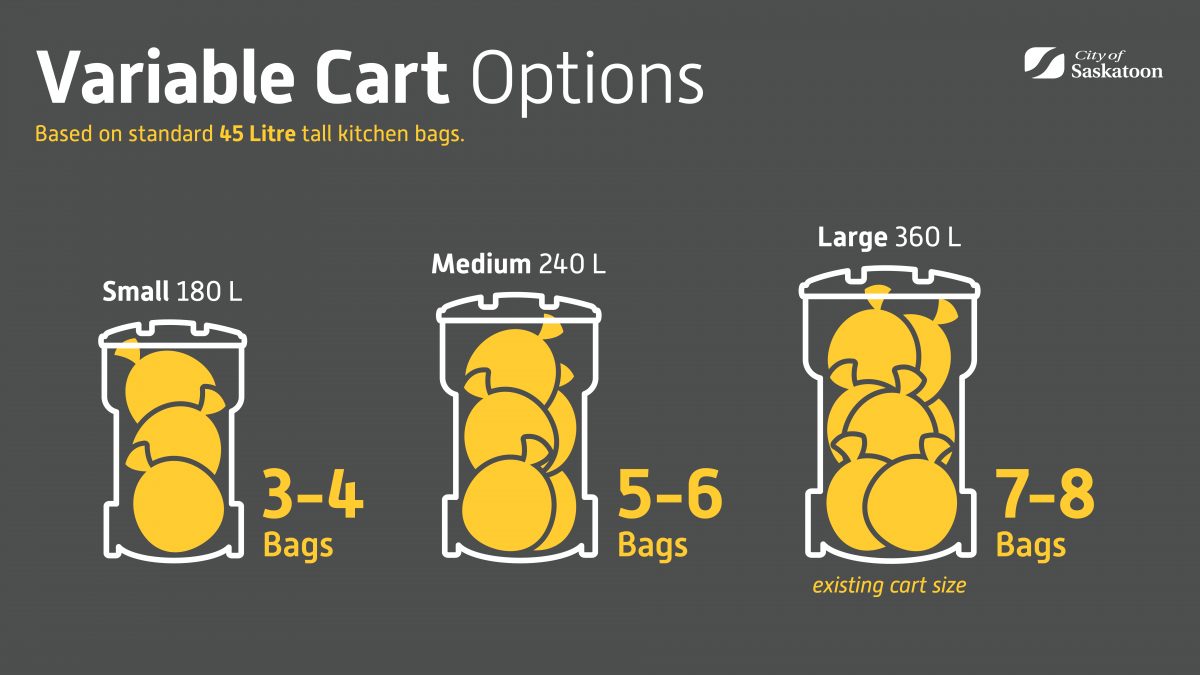
“Moving to a volume-based cart program will give residents choice based on their waste needs and it’s one of many components under the City’s Waste Reduction and Diversion Strategy to meet our waste diversion goals,” Lemke says. “We recommend Option 1 to City Council because it increases the customer’s control over their costs and provides financial incentives for waste diversion at a lower overall investment.”
The full report and attachments (appendix 1; appendix 2) can be found here.
For more information on waste and recycling, visit saskatoon.ca/wastediversion.
City to recognize National Day for Truth and Reconciliation as statutory holiday
August 31, 2021 - 4:10pm
The City of Saskatoon will mark the National Day for Truth and Reconciliation as a statutory holiday on September 30, following unanimous approval of City Council at its meeting held last night, August 30.
“It is important that we show leadership in this area, to honour what we’ve heard from Survivors in our community about the impact of Indian Residential Schools,” says Mayor Charlie Clark. “Elders, Survivors and members of the Indigenous Community have been reaching out to non-Indigenous members about building a better future together, based on truth and reconciliation. By marking the National Day for Truth and Reconciliation, we are recognizing how important this is in continuing our journey forward.”
The Government of Canada passed legislation in June to make September 30 a federal statutory holiday for federally regulated workers in the public and private sector. Following Council approval, starting September 30, 2021, the National Day for Truth and Reconciliation will become a designated paid holiday for all City employees to recognize and commemorate the legacy of residential schools.
The federal government created this federal statutory holiday in response to the Truth and Reconciliation Commission’s Call to Action number 80: to honour Survivors, their families, and communities, and ensure that public commemoration of the history and legacy of residential schools remains a vital component of the reconciliation process.
Unmarked graves at residential schools in Saskatchewan and across the country have raised awareness about the “truth” of residential schools. It is more important than ever to ensure that education and awareness continues and the honouring of residential school survivors and the children who did not make it home is done appropriately.
The City of Saskatoon continues to champion and implement the Truth and Reconciliation Calls to Action by working with community partners to ensure the City contributes to the collective movement. To support efforts to elevate the significance of September 30, the City is working with Reconciliation Saskatoon and other Indigenous organizations to develop messaging and tools to encourage people to take on their own Calls to Action, take up an initiative at their workplaces, encourage the community to read the Calls to Action and find out on how to get involved.
Also known as Orange Shirt Day, wearing orange on September 30 will continue to be a way to honour Indian Residential School Survivors, their families, and those who didn’t make it home. It’s a way to acknowledge the legacy of Indian Residential Schools, demonstrate a commitment to reconciliation, and affirm Every Child Matters.
For more information on activities and initiatives to support reconciliation and see civic services and holiday hours on September 30, visit saskatoon.ca.
Year-round reduced speeds now in effect for School Zones and new Playground Zones
August 31, 2022 - 10:00am
Saskatoon families may feel a stronger sense of safety in areas where their young children learn and play as changes to School Zones and new Playground Zones start tomorrow, September 1.
Speed limits in School Zones at elementary schools will be 30 km/h every day, all year from 7:00 a.m. to 7:00 p.m. Additionally, some school zone boundaries were adjusted and the reduced speed limit was removed from High School Zones. U-turns are still restricted at all schools between posted School Zone signs.
“Slowing from 50 km/h to 30 km/h where children play gives the driver more time to react, a wider field of vision and a chance to come to a complete stop sooner,” says Jay Magus, Director of Transportation. “Children are more vulnerable to severe injury in a crash than adults, so should a crash occur, it is less likely that it would have severe consequences at a reduced speed.”
Playground Zones are new in Saskatoon and require drivers to slow to 30 km/h as posted, when passing areas where children play. Where School and Playground Zone signs do not include a posted speed limit, treat the sign as a caution and pay close attention through the area.
Speed enforcement activities will be aligned with the new School Zone and Playground Zone effective hours.
“It’s critical for people to slow down in these areas where young children play and learn,” said Dale Solie, Inspector, Saskatoon Police Service. “Initially our focus will be to educate and raise awareness of the school zone and playground changes; however, enforcement will occur where necessary.”
Vehicle speed and pedestrian safety have been the top concerns of residents who participated in 77 Neighbourhood Traffic Reviews between 2013 and 2021, and many people felt that vulnerable people, such as children, were at risk of injury.
Following a city-wide speed limit review for residential streets in 2021, City Council approved changes to extend School Zones to year-round with longer hours and implement playground zones. Learn more at saskatoon.ca/speedlimit.
Butterflies have arrived at the Prairie Butterfly House
August 31, 2022 - 8:15am
- PrairiesCan
- Norplex Business Centre
- Hunter Family
- Duval Family
- Ultravision Construction
- one-mouse graphic design
- Dutch Growers
- ADA Architects
- Laser Impressions
- ASL Paving
- ASSA ABLOY Entrance Systems Canada
The Saskatoon Forestry Farm Park & Zoo (Zoo) is pleased to announce the arrival of the butterflies at the Prairie Butterfly House. Visitors to the Zoo can now see several butterflies fluttering around the new exhibit and will also have an opportunity to check out the emerging area where caterpillars form a chrysalis or pupa to rest and transform into an adult butterfly.
“We are thrilled to officially open the new Prairie Butterfly House,” says Jeff Mitchell, Zoo Manager. “The butterflies truly bring the exhibit to life, and we can’t wait for people to come and fully experience the beauty and tranquility of this new exhibit.”
In addition to the butterflies, interpretive signage has also been installed providing an opportunity for visitors to learn more about the many species of butterflies that will inhabit the space.
The Zoo would once again like to thank the Saskatoon Zoo Foundation and all of the partners, contributors and organizations that helped bring this exhibit to life.
The Zoo is open daily from 9:00 a.m. to 7:00 p.m. Visit saskatoon.ca/zoo to learn more and to plan your next visit.
City in negotiations with Ideas Inc. to manage Farmers’ Market Building
August 30, 2021 - 10:32pm
The City of Saskatoon is pleased to announce that Ideas Inc. has been selected through a public Request for Proposal process as the preferred proponent to lease the Farmers’ Market Building. The City and Ideas Inc. have been working together since February 2020 to negotiate a formal lease agreement to manage the public facility at River Landing.
“This is an exciting opportunity for our organization to bring vibrancy and animation back to the area. We are currently in the process of negotiations with the City and we remain committed to the project. We hope that we can reach an agreement in due course and help create an amazing facility here in Saskatoon,” says Depesh Parmar, Executive Director of Ideas Inc.
At its August 30, 2021 meeting, City Council was advised that Ideas Inc. was the proposed tenant for the Farmers’ Market Building. The Administration also outlined next steps to continue negotiations and options to renovate the Farmers’ Market Building so it may operate with business activities a minimum of six days per week with an emphasis on local foods and products and a farmers' market component.
“Ideas Inc. is an established business incubator and has helped provide a platform to numerous startups to launch and grow into successful businesses,” says Lesley Anderson, Director of Planning and Development. “As advocates of small business and entrepreneurship, they are the perfect organization to manage this exciting project.”
Ideas Inc. is conveniently located adjacent to the Farmers’ Market Building and has been managing the outdoor Street Stall Saturdays and the seasonal outdoor farmers’ market for two seasons. Ideas Inc. will also continue to manage the seasonal outdoor farmers’ market in Market Square.
The proposed vision for the Farmers’ Market Building is an animated public facility with vendor spaces and dedicated farmers’ market days. This vision includes the building being fully utilized and open to the public six days per week, year-round.
“Our vision for this space draws inspiration from national and international facilities that have become landmarks for their respective cities. We are inspired by their ability to create a vibrant, animated space for local communities, and a dynamic and diverse destination where patrons can enjoy everything local from produce and artisan goods, to locally produced food and beverage,” says Depesh Parmar, Executive Director of Ideas Inc.
City Council approved the hiring of a design consultant to prepare the building for the next phase. The City anticipates that pending approval of capital funding for 2022, the upgraded public facility could be operational by Fall 2022.
For more information on the Farmers’ Market Building at River Landing, visit saskatoon.ca/farmersmarket.
Masks required on Transit & indoor City-operated facilities; City also implements new staff health, safety measures including rapid tests
August 30, 2021 - 9:00pm
- The potential implementation of vaccine requirements for City staff only, in consultation with local health authorities; and
- Following the Government of Saskatchewan’s update on August 30, 2021 that “businesses, municipalities, venue and event organizers may request proof of vaccination to host and attend events or access their services,” to provide Council with advice on how this could apply to civic events, events in civic facilities and other relevant gatherings.
Council seeks public input on arena/event centre locations: artistic illustrations revealed
August 29, 2022 - 3:15pm
-
Site A – Midtown Shopping Centre North Parking Lot
-
Site B – North Downtown/City Yards
-
A representative sample survey (that includes a telephone and online panel survey) for Saskatoon residents.
-
An opt-in online public survey (Saskatoon residents, as well as those from other communities, can self-select to participate);
-
An opt-in survey for local businesses and organizations; and
-
Intercept surveys to hear from residents across Saskatoon.
With artistic illustrations revealed Monday, the public has its first look at what a future event centre/arena could look like at either of two potential Downtown locations and now City Council wants to hear from residents, businesses and other community partners on the opportunities and challenges of those two potential sites.
“We have a chance to make decisions that will shape the downtown and the city for the next 50 years and beyond,” says Mayor Charlie Clark.
“The illustrations give people an idea of what the District could look like and how exciting and dynamic this will be. A lot of the design detail will still need to be worked out ultimately by architects, partners, and working with the community. These are simply possible concepts.”
Council approved at its August 29 meeting a report outlining a detailed technical study of potential Downtown locations for a new event centre/arena, which will become one of the key anchors of the future Downtown Event & Entertainment District.
Artistic illustrations of the two potential sites presented at the meeting are now available on the City website at saskatoon.ca/eventdistrict.
Five different site options for the Downtown event centre/arena were initially studied to determine if they were a suitable size for a modern event facility, with a capacity comparable to the existing SaskTel Centre. Sites determined to be too small were eliminated from further consideration, while the remaining sites were ranked in accordance with nine evaluation criteria. After thoroughly studying the evaluation criteria, two sites are considered viable options:
Council also approved an engagement plan which will start this week. Public engagement on the two locations was not possible until the Midtown north parking lot was available following lengthy real estate discussions.
“This was probably the most complex land negotiations in the City’s history,” says Dan Willems, Director of Technical Services. “Engaging prior to the conclusion of negotiations would have significantly reduced the opportunity for the City to secure conditional purchase agreements within a competitive market price range.”
From August 30 to October 3 the City will seek public input in several ways:
August 30 to September 5:
September 13 to October 3:
This engagement method reflects the “consult level” of the International Association for Public Participation using a qualitative approach. Results will be shared publicly and presented to City Council in November to be considered as part of the final decision on the location for the future event centre/arena site.
The event centre/arena site and surrounding area, will be developed as a shared public space where everyone feels comfortable and welcome. Coupled with a convention centre, it will act as an anchor for the rest of the District development. The future Bus Rapid Transit (BRT) system will connect the District to the entire city, boosting revitalization of the Downtown.
The District will also be a destination and gathering place for all of Saskatchewan and beyond.
"We already know that many more people travel from outside Saskatoon for concerts and events, and we want to continue to offer those events and opportunities for all of us to enjoy well into the future,” says Councillor Troy Davies, co-chair, Downtown Event & Entertainment District Advisory Group. “This will be a game changer for Saskatoon and the province -- we are building this facility for our kids and grandkids.”
By offering residents and visitors a gathering place for entertainment and events, with a variety of restaurants, venues, shopping and nightlife, Saskatoon’s Downtown will become an economic driver for the city and the province.
The creation of a successful District will have significant benefits for Saskatoon — a new Downtown event centre/arena, a new or enhanced convention centre, and the future BRT are the key public infrastructure investments that will drive further investment in the Downtown area, Saskatoon, and Saskatchewan -- helping businesses attract the workforce and talent they demand.
Following further engagement and consultation with elders and community partners, the area would be developed sustainably with Indigenous placemaking a focus.
More information on The Journey to the District is available on saskatoon.ca/eventdistrict.
City receives grant to fund active pedestrian corridor at McKercher Drive and Edinburgh Place
August 30, 2021 - 11:00am
The intersection at McKercher Drive and Edinburgh Place has a new Active Pedestrian Corridor (APC) device to provide a safer pedestrian crossing experience, thanks to grant funding from the provincial Traffic Safety Fund as provided by Government of Saskatchewan.
“Due to high traffic volumes and width of the street, crossing McKercher Drive can be quite challenging for pedestrians,” says Jay Magus, Director of Transportation. “The installation of an Active Pedestrian Corridor device will provide a safer environment for both pedestrians and motorists."
Earlier this year, the City received nearly $18,000 grant funding to install two overhead, pole-mounted, flashing crosswalk signs, which are activated by a push-button mounted on each side of the intersection.
The improved pedestrian crossing was installed this summer and is now operational.
Provincial Traffic Safety Fund grants are awarded twice annually. The City plans to continue submitting funding applications to improve safety at other intersections and school zones throughout Saskatoon.
City of Saskatoon 2020 Annual Report and Financial Statement Report now online
August 26, 2021 - 3:58pm
The City’s 2020 Annual Report which includes the Audited Consolidated Financial Statements is now available online at: saskatoon.ca/annualreport. New this year is a condensed 2020 Financial Statement Report prepared to underscore the City’s goal to make financial records easier to access and review.
Having received the opinion of external auditor, Deloitte LLP, Chartered Professional Accountants, the 2020 Annual Report reflects the City’s ongoing commitment to continuous improvement, accountability, transparency and clarity in financial reporting.
“In an unprecedented year, the City continued to make responsible financial decisions to reduce our overall spending approach and make up shortfalls by using the Fiscal Stabilization Reserve,” says Kerry Tarasoff, Chief Financial Officer. “Our work with other orders of government on solutions and financial assistance greatly helped address funding needs to minimize our operating revenue challenges and deficit.
“The 2020 Annual Report highlights the progress we made on our investment activities, projects, and service delivery, and details what we planned and accomplished as set out in our Multi-Year Business Plan and Budget, adds Tarasoff. Our prudent financial planning and decision-making in 2020 helped to keep us financially responsible even in these uncertain times.”
The City continued to maintain its S & P Global ‘AAA/ Stable’ credit rating in 2020, supported by the City’s cautious financial decision-making and willingness to explore innovative and alternative ways to fund, finance, deliver and make progress on important infrastructure projects.
Included within the full 2020 Annual Report is a summary of achievements and highlights of several major projects and initiatives according to business line.
“Throughout a very challenging year, we committed to careful and stringent financial management to plan for financial recovery and to build a vibrant future for the people of Saskatoon,” says Jeff Jorgenson, City Manager. “With our strong financial management practices and the hard work of every part of our organization pulling together, the City was able to balance the budget while protecting our strategic priorities, our critical assets, and our commitments to Saskatoon citizens and our employees.”
Even with the challenges of the pandemic, the City continued to value citizen input by providing numerous public engagement opportunities through online surveys and online public meetings. To provide business continuity, several City services were fast-tracked to be available online.
With a goal of being one of the best-managed cities in Canada, the City of Saskatoon remains dedicated to ensuring residents receive value from the investments made through their tax dollars and managing both risk and debt appropriately.
In keeping with the City’s digital-first strategy to capture cost savings and environmental responsibility, the 2020 Annual Report and 2020 Financial Statement Report are made available online and will not be printed. Citizens may request an individual printed copy by contacting finance@saskatoon.ca.
The 2020 Financial Statements were presented to City Council on July 26, 2021.
Visit saskatoon.ca/annualreport for additional financial reports and information.
Report outlines arena/event centre locations & public engagement plan
August 24, 2022 - 3:14pm
- Site A – Midtown Shopping Centre North Parking Lot
- Site B – North Downtown/City Yards
- A representative sample survey (that includes a telephone and online panel survey) for Saskatoon residents.
- An opt-in online public survey (Saskatoon residents, as well as those from other communities, can self-select to participate);
- An opt-in survey for local businesses and organizations; and
- Intercept surveys to hear from residents across Saskatoon.
If City Council approves a plan to consider two feasible sites for a future Downtown event centre/arena, the public will have the opportunity to provide feedback through a process of public engagement that would begin in the coming days.
A report will be presented to the August 29 meeting of City Council outlining a detailed technical study of potential Downtown locations for a new event centre/arena, which will become one of the key anchors of the future Downtown Event & Entertainment District.
Five different site options for the Downtown event centre/arena were initially studied to determine if they were a suitable size for a modern event facility, with a capacity comparable to the existing SaskTel Centre. Sites determined to be too small were eliminated from further consideration, while the remaining sites were ranked in accordance with nine evaluation criteria. After thoroughly studying the evaluation criteria, two sites are considered viable options:
Public engagement on the two locations was not possible until one of the sites was available following lengthy real estate discussions. The Council report includes an engagement plan for approval.
“Based on the technical criteria, the Midtown location is the highest scoring site and affirmed by two external consultants,” says Dan Willems, Director of Technical Services.
“The public engagement will be an opportunity to hear from residents, businesses and other community partners on the opportunities and challenges of both potential sites. The public feedback, along with the technical rankings, will give City Council the information it needs to make the final decision on the event centre/arena location.”
From August 30 to October 3 the City will seek public input in several ways:
August 30 to September 5:
September 13 to October 3:
This engagement method reflects the “consult level” of the International Association for Public Participation using a qualitative approach. Results will be shared publicly and presented to City Council in November to be considered as part of the final decision on the location for the future event centre/arena site.
“Since 2018, when City Council decided a future event centre/arena should be located Downtown, a lot of research, consideration and effort has gotten us to this point,” Willems says. “The goal evolved beyond the need for a new event centre/arena to envision a revitalized Downtown that is welcoming for everyone to work, play and live.”
The event centre/arena site, along with the convention centre, will act as an anchor for the rest of the District development. The future Bus Rapid Transit (BRT) system will connect the District to the entire city, boosting revitalization of the Downtown area.
“The vision of an event and entertainment district is one of a shared public space where everyone feels comfortable and welcome,” he says.
The area would be developed sustainably with Indigenous placemaking a focus. By offering residents and visitors a gathering place for entertainment and events, with a variety of restaurants, venues, shopping and nightlife, Saskatoon’s Downtown will become an economic driver for the city and the province.
“The creation of a successful District will have significant benefits for Saskatoon — a new Downtown event centre/arena, a new or enhanced convention centre, and the future BRT are the key public infrastructure investments that will drive further investment in the Downtown area, in Saskatoon and in Saskatchewan.”
The report being considered by City Council can be found at saskatoon.ca/agendas. If approved, more information will be made available starting Tuesday, August 30 on saskatoon.ca/eventdistrict.
Saskatoon Forestry Farm Park & Zoo celebrates 50 years
August 24, 2022 - 9:00am
On September 1, 1972, the City of Saskatoon completed a $160,000 renovation to expand the Sutherland Forest Nursery Station to include an animal park. Since then, a wide variety of exotic species and western Canadian animals have called the Saskatoon Forestry Farm Park & Zoo home.
“It’s pretty amazing to look back and reflect on all of the animals that have become part of the Zoo family over the past 50 years,” says Jeff Mitchell, Zoo Manager. “We have had some amazing animal ambassadors over the years, including grizzly bears Mistaya and Koda who have called the Zoo home for more than 15 years”.
Since opening the expanded facility in 1972, the Zoo has become home to several species of animals. Some animals have incredible stories of survival like Sammis the pronghorn who was delivered via c-section by a conservation officer after his mother was hit by a car. Sammis was brought to the zoo where he was bottle fed and is now thriving as part of the pronghorn herd. Many other zoo residents like the red-tailed hawk, snowy owls and bald eagles sustained injuries preventing them from being able to survive in the wild, and several other species like the snow leopard and Goeldi’s monkeys participate in important conservation research and education programs to ensure the survival of their species.
To celebrate the milestone, the Zoo will be organizing a variety of enrichment activities for the animals at the Zoo and will be offering a special 50th anniversary daily admission rate on Thursday, September 1, 2022. Daily admission rates will be $5 for adults (18+), $5 for youth (6-18) and $10 for families (a group of up to seven individuals with a maximum of 2 adults). Children under 6 always receive FREE admission to the Zoo. Parking fees will remain in effect at $4 per vehicle.
“Our animals will be very excited to see what our team has in store for them to mark the occasion,” says Mitchell. “Our zookeepers have been working on a variety of enrichment activities that will promote mental and physical stimulation and also provide an opportunity for the animals to participate in the celebrations. We encourage everyone to come out and visit our species ambassadors and see some of the fun activities we have in store for them.”
The Zoo is open daily from 9:00 a.m. to 7:00 p.m. Visit saskatoon.ca/zoo to plan your visit.
Saskatoon Forestry Farm Park & Zoo Background
Established in 1913, the Sutherland Forest Nursery Station researched and produced trees adapted for growth in the prairie climate. For over 50 years, millions of seedlings were grown and shipped to farms throughout the Prairie Provinces, helping to ensure the success of prairie farming by providing protection from harsh weather and beautification of the landscape. The Nursery Station was closed in 1965 and was purchased by the City of Saskatoon and re-opened in 1972 as the Saskatoon Forestry Farm Park & Zoo. Today, the Saskatoon Forestry Farm Park & Zoo is a National Historic Site boasting restored heritage buildings, carefully-crafted garden spaces and Saskatchewan’s only CAZA accredited zoo.
2022 Rock Your Roots Walk for Reconciliation rescheduled for September 30
August 23, 2022 - 9:32am
The Rock Your Roots Walk for Reconciliation has been rescheduled for September 30, following the cancellation on June 21 due to extreme weather. The event will take place on the National Day for Truth and Reconciliation (September 30) between 10:00 and 11:30 a.m. The walk will begin at Central Urban Métis Federation Inc. (CUMFI) and end at the “Where our Paths Cross” Reconciliation Circle art installation in Victoria Park (across the road from 422 Spadina Cres W).
“The significance of a walk can be attributed to the Sunday walks in residential schools; this was often the only time when siblings and cousins of different genders might be reunited,” says Judy Pelly, a Residential School Survivor and member of the Rock Your Roots Walk organizing committee. “It’s meaningful to see Indigenous and non-Indigenous peoples come together in this way.”
Rock Your Roots is put on by Reconciliation Saskatoon, which the City of Saskatoon co-chairs along with the Office of the Treaty Commissioner. The event, which has seen attendance in the thousands in past years, was first held in 2016. The intent of this event is to answer the Truth and Reconciliation Commission of Canada's Calls to Action by demonstrating a commitment to Reconciliation, honouring Residential School Survivors, and continuing work towards an inclusive community.
“This walk is an opportunity to learn about and honour First Nation and Métis residential school survivors,” says Shirley Isbister, President of Central Urban Métis Federation Inc. (CUMFI). “It’s an inclusive event that welcomes everyone to come out and participate. We look forward to being together.”
Individuals of all ages are invited to attend—alone or as part of a group. Workplaces and other organizations are encouraged to send a team and invited to come outfitted with banners showcasing their organization’s support for Reconciliation. Many schools will be closed for the day in honour of the National Day for Truth and Reconciliation which presents an opportunity for parents to bring their children and partake in this powerful Reconciliation event together. Cultural performers will 'rock their roots' to start and end the walk, sharing their culture and showcasing Saskatoon's incredible diversity.
“Rock Your Roots is an opportunity to bring our community together to understand and be educated on residential schools and how they have negatively impacted Indigenous peoples,” says Saskatoon Tribal Chief Mark Arcand. “This walk is a symbol of Reconciliation and a commitment to change for the better, so that all people can have a good quality of life.”
“Rock Your Roots represents an acknowledgment of the multi-generational impacts of residential schools and a commitment to Reconciliation,” says Saskatoon Mayor Charlie Clark. “It’s a public demonstration of support for residential school attendees and those lost. It’s a promise to work towards a future that affords every member of our community equal opportunity.”
This event is open to all and there is no charge for participating. Walk participants are invited to wear their cultural dress or symbols, an EveryChildMatters shirt, or any other orange shirt. For the latest event information, follow the Rock Your Roots Facebook Event.
Finance Committee to hold special meeting to review 2022 & 2023 Indicative Budget
August 19, 2021 - 9:24am
- Online through the Submit a Letter/Request to Speak to Council and Committees form
- By post or in person to: Office of the City Clerk, 222 - 3rd Avenue North, Saskatoon, SK S7K 0J5
- By fax to 306-975-2784
Members of City Council’s Standing Policy Committee on Finance will review options for setting the indicative rate for the 2022 and 2023 budget at a special meeting on August 31 at 1 p.m.
At the June 21, 2021, Governance and Priorities Committee (GPC) meeting, members asked for a deferral to set the indicative rates for 2022 and 2023 to a later date, in order to further explore options to address the property tax pressure residents and businesses face in this unprecedented year, and to recognize the funds required to maintain quality services and address strategic priorities of City Council.
Setting the indicative rate is not to finalize the property tax rates. It is the starting point in the budget building process and for 2022 and 2023, whereby the estimated rates presented are for a status quo budget. The estimated property tax rates presented at the June 21 GPC meeting of 5.96% in 2022 and 5.42% in 2023 are the rates required to keep all City services and service levels the same as what residents have been receiving.
Input from residents and the business community is being welcomed as part of this review of the proposed indicative rates. Those wishing to participate or share their input on the 2022 and 2023 indicative rate may submit their intent in the following ways:
Interested residents and businesses are encouraged to contact the City Clerk's Office at 306-975-3240 to clarify the requirements for sharing input at this Special Meeting.
The indicative rate guides the Administration in preparing the multi-year budget to allocate resources to the services, programs and initiatives within Council’s priority areas outlined in its 2022-2025 Strategic Plan, which will be released in early fall.
Visit saskatoon.ca/budget for more information on the City’s 2022/2023 Multi-Year Business Plan and Budget process.
City to provide more information on city-wide curbside organics collections and funding implications
August 18, 2021 - 4:14pm
- Implications for the funding and operations of waste programs, including the organics program, if funding for the organics program moved to a utility model.
- The option to outsource collections with an affordability threshold, including triple bottom line analysis, that reflects as many factors as possible to ensure that we achieve the best overall organics collection with price and service.
- Curbside Organics Collection: Affordability Threshold and Triple Bottom Line Approach to Tendering Collections
- Solid Waste Program Funding Models: Implications and Considerations for Change
On Monday, August 23, the Administration will present two information reports to the Governance and Priorities Committee (GPC). This is in response to the requests made by GPC at its June 21 meeting, that the Administration report back on the following:
“We are thoroughly assessing all options as we implement this new service for residents, both financially and operationally, but also with our sustainability commitments in mind,” says Brendan Lemke, Director of Water and Waste Operations. “We welcome the opportunity to conduct further review, where necessary, and provide City Council with the information required to ensure the success of this program. After an unprecedented and challenging year, it is important that we ensure the decisions made in 2019 reflect and compliment the environment we are in today.”
The City established a contract with Green Prairie Environmental Ltd. in August 2020 to manage organics processing, while a decision on collections has yet to be made. The city-wide curbside residential organics program is expected to launch in spring 2023.
Administrative Reports & Attachments:
Progress updates and a decision history can be found at saskatoon.ca/curbsideorganics.
Year-end options for cost reductions being considered to maintain balanced budget
August 10, 2022 - 4:30pm
A mid-year forecast to be considered by the Standing Policy Committee on Finance shows that rising fuel prices and a snowy start to 2022 have contributed to a projected deficit within the City of Saskatoon’s 2022 Corporate Business Plan and Budget.
As outlined in the information report being presented to committee on August 15, the City is currently projecting a 1.17% unfavourable variance from budget, or an approximately $6.8 million deficit.
“This is due in large part to higher than anticipated gas and diesel prices, which had a $3.5 million impact on the budget, and to high snow accumulations in the first half of 2022, which resulted in a projected $3 million unfavourable variance,” says Kari Smith, Director of Finance.
The projection also includes over expenditures in Information Technology, and various other revenue failing to reach budget, such as those for Fines and Penalties and Leisure Centres.
The mid-year forecast does include several positive trends, notes Smith, including $2.5 million in administrative savings from reduced training and travel and staff vacancies, $1.05 million in higher than anticipated investment returns from rising interest rates, and a $1.13 million increase in Municipal Revenue Sharing. However, due to such favourable variances being used to offset the rising cost of fuel and other shortfalls, Administration is currently projecting an overall deficit of $6.8 million.
Various year-end deficit reduction options of up to $4.2 million have already been developed and reported on, including a one-time increase to the Return on Investment from the Water Utility, returning capital funds back to operating as opposed to reserve, and deferring reserve contributions to mitigate the deficit.
“The mid-year forecast is our best estimate of the 2022 budget position at this time and is still subject to substantial change throughout the second half of the year,” says Smith. “Administration will continue to monitor and manage the 2022 budget and do everything we can to reduce the deficit while still delivering the services Saskatoon residents expect. Although the City has reserves in place to cover a deficit of this magnitude, our goal for 2022 is to avoid leaning on our fiscal stabilization reserve.”
Utilities are expecting a $1.2 million net surplus mostly due to additional revenue in Waste Services and Saskatoon Light and Power, offset by lower revenues and additional costs in Water and Wastewater Utilities. Any utility variance will be offset through transfers to or from the applicable stabilization reserves.
Climate Commitment established between City and USask
August 9, 2021 - 10:07am
The City of Saskatoon (City) and the University of Saskatchewan (USask) have developed a Climate Commitment and Call to Action with an aim to speed up the transition to a green community.
To formalize this pledge—which progresses the goals of a first-of-its-kind 2017 Memorandum of Understanding (MOU) between a Canadian university and municipality—the Climate Commitment and Call to Action has been presented to the City’s Standing Policy Committee on Environment, Utilities and Corporate Services (EUCS) on Monday morning, Aug. 9, 2021.
“There are many co-benefits that can result from this strong partnership and project collaboration. The City, USask, Saskatoon residents and students can expect to benefit from lowered emissions and pollution and environmental protection which make the world around us healthier,” says Jeanna South, Director of Sustainability. “Equity and reconciliation are top priorities throughout this commitment, thus we also expect to see improvements in our relationships and quality of life.”
While both the City and USask have their own climate action plans, this additional commitment will provide common ground between the institution and municipality in order to make way for easier collaboration.
“We are excited to be taking this important step to further develop our relationship with the City on this urgent and accelerating policy challenge,” says Julian Demkiw, Senior Strategist for USask.
If approved by City Council, the first steps will involve sharing information on climate baselines and expanding student engagement. Further work will explore collaboration opportunities around equitable climate action on topics such as energy efficiency and biodiversity conservation.
Visit research.usask.ca/research-junction for more information on collaborations between the City of Saskatoon and the University of Saskatchewan.
Saskatoon Forestry Farm Park & Zoo saddened to announce the loss of Malcolm the cougar
August 5, 2021 - 2:00pm
In early March, the animal care staff observed Malcolm having difficulty walking and jumping. A physical exam was performed and arthritis was seen in his joints. Veterinarians had been treating his symptoms with medication to help ease the pain; however, this week his well-being declined significantly and the difficult decision was made to humanely euthanize him.
Malcom, who was considered geriatric, arrived at the Saskatoon Forestry Farm Park & Zoo in 2009 and made his permanent home at the Nutrien Ark.
“Malcolm was an amazing ambassador for his species,” said Jeff Mitchell, Zoo Manager. “In his 12 years at the Zoo, many people had the opportunity to learn more about cougars and we know everyone who had a chance to see him, cared about him as much as we did”.
Cougars have a life expectancy of 9-13 years and range from the north Yukon down to the Andes Mountains in South America. They are classified as Least Concern on the endangered species list but are considered endangered in several provinces in Canada.
City exploring second Water Treatment Plant to serve future population
August 4, 2022 - 8:30am
The City of Saskatoon has a responsibility to provide clean drinking water to a growing population through an efficient and reliable water treatment and distribution system. Since it was established in 1906, Saskatoon’s Water Treatment Plant has been expanded to a treatment capacity of 250 million litres per day (MLD). The plant, along with reservoirs and pump stations, serve the city and several surrounding municipal and rural customers.
“We will continue to utilize and upgrade our current Water Treatment Plant and infrastructure for years to come, but we need to begin planning the development of a second plant to increase treatment capacity,” says Pamela Hamoline, Interim Director of Saskatoon Water. “A second plant would eventually bring our total treatment capacity to 450 ML per day, which is necessary for an expected population of 500,000 in the coming years.”
On Monday, the Water Treatment Long Term Capital Strategy will go before the City’s Standing Policy Committee on Environment, Utilities and Corporate Services. The report highlights the current and future steps needed to increase treatment capacity.
“Despite many successful water conservation efforts, as well as maintenance and upgrades over the years, it is unrealistic to depend on our 116-year-old Water Treatment Plant to keep up with future demand,” says Hamoline.
Hamoline says an internal Decision Quality Team is committed to ensuring the alignment of the City’s Strategic Goals in determining a treatment plant expansion strategy, including the goal of Environmental Leadership to reduce the City’s environmental footprint and promoting responsible use of resources.
“The team still has a lot of work to do and is currently exploring funding strategies so it can report the findings to City Council. That work will include looking into opportunities and partnerships with Federal and Provincial funding programs.”
The City has a draft Engagement Plan in the works as well, focusing on identifying major stakeholders and opportunities for proactive public communication.
For more information about the Water Treatment Plant, history, distribution system, and treatment process, visit saskatoon.ca/water.
Construction underway on Saskatoon’s waste diversion facility
July 28, 2021 - 10:05am
- mixed metals
- appliances
- construction and demolition waste
- rigid plastics
- household hazardous waste
- bicycles
- used oil and antifreeze
- elm wood
With the concept and site design approved by City Council, construction is in full swing on Recovery Park. The facility, next to the landfill, will be Saskatoon’s one-stop point for easy, efficient, and cost-effective waste diversion.
“This project has been years in the making so it’s great to be at the stage where work is now happening on the site,” says Bryan Zerebeski, Senior Project Management Engineer, Technical Services. “The site has been cleaned up and cleared and soon we’ll get started on new weigh scales and new administrative and equipment storage buildings. The site will be landscaped and when Recovery Park opens in 2023, Saskatoon will experience a very easy and well-organized facility for waste and recycling.”
A new road into the Recovery Park site has already been built and will open on August 9, 2021. Visitors will still access the landfill off Valley Road but will be directed onto the new road while the existing one is decommissioned.
Recovery Park was designed to improve recycling options at the landfill and provide space to develop future diversion opportunities. The materials being considered for acceptance include:
Right now, the City diverts 24 per cent of its garbage from the landfill. With Recovery Park, curbside organics and the Industrial, Commercial and Institutional Regulation all launching in 2023, the waste diversion rate is projected to increase to 41-54 per cent.
Under the Investing in Canada Infrastructure Program, the Government of Canada will fund up to $7.8 million toward the Recovery Park project and the Government of Saskatchewan will contribute up to $6,499,350. The City of Saskatoon will fund the remainder of the $37.5 million project and any additional costs.
For more information on Recovery Park and to see the facility layout, visit saskatoon.ca/recoverypark.
Saskatoon Transit celebrates low floor Access Transit buses
July 28, 2021 - 9:30am
- Trip planning
- Wayfinding and navigation
- Fares
- Boarding and exiting
- Accessible features
- Problem solving tips for when unexpected challenges occur
Today, Saskatoon Transit celebrates a milestone on its journey towards providing more accessible options for customers with reduced mobility, providing everyone the freedom and independence to travel safely throughout the city.
As part of regular transit funding, in part by the Provincial Transit Assistance for People with Disabilities (TAPD) program, Access Transit purchased two low-floor buses. These new buses allow those with reduced mobility the freedom and independence of using a ramp versus a lift or stairs to enter and exit the bus.
These buses feature a ramp and an innovative INQLINE system to assist operators in boarding passengers safely. The low floor design removes the need to use a lift or stairs to gain access to the bus, creating an improved customer experience.
“I’m very proud that Access Transit has incorporated low-floor buses into the fleet. We are excited to see how these new vehicles will improve accessibility for our passengers,” says Jim McDonald, Director of Saskatoon Transit.
The addition of these buses allows Saskatoon Transit to bridge the gap between Access Transit and fixed-route transit using a “Family of Services” approach. Access Transit customers now have the option of using a ramp to enter and exit Access Transit buses allowing them to build the confidence to perhaps add the flexibility and spontaneity of fixed-route or On-Demand transit to their transportation options. The City encourages Access Transit customers to use fixed-route services as a supplement to Access Transit when it is convenient for them and when conditions allow.
“We are continually working to improve our service. We want all of our customers to have safe and convenient transit options,” says Tracey Davis, Access Transit Manager. “Accessible transportation is a building block for a fair, inclusive, and equitable society. Providing as much flexibility in Saskatoon Transit’s fleet of buses improves that accessibility.”
The Experience Transit Travel Training program is available for those who may be interested in adding fixed-route or On-Demand Transit to their transportation options. Experience Transit began as a pilot in mid-2017. The program is a personalized, 60-minute training to introduce people to transit and teach them how to use fixed-route transit services independently. Training is customized to fit an individual’s lifestyle, travel needs and abilities. The program includes:
To see a video of the low-floor bus ramp visit the City of Saskatoon’s YouTube channel.
From point A to point B: Transit launches NEW OnDemand Transit service
July 28, 2022 - 9:30am
Residents of Saskatoon will soon be able to request public transit service using the Saskatoon Transit OnDemand app from designated stops to the nearest transit hub and vice-versa. The OnDemand Transit (ODT) service will connect the new neighbourhoods of Brighton/Rosewood, North Kensington and Blairmore with fixed route service, to fill service gaps in those areas.
“This is all about service,” says Tracey Davis, Interim Director, Saskatoon Transit.
“We want to provide people with as much flexibility as possible - especially in developing neighbourhoods where full public transit options don’t yet exist. Our OnDemand Transit service is just the thing to meet this challenge head on.”
The new ODT service will begin August 2 and will be fully integrated with the current fixed-route transit system. OnDemand will also be available in Transit, Saskatoon Transit’s all-in-one app to plan, track and pay for rides. Thanks to this integration, riders can, for the first-time plan trips that combine Saskatoon's OnDemand and fixed-route services. Passengers can plan a trip in Transit to their destination using a combination of OnDemand and fixed-route service, then link directly to the Saskatoon OnDemand app to request their ride. Trips can be requested in multiple ways: the Saskatoon Transit OnDemand mobile app, website, or phone (306-975-3100).
To make this all work in a coordinated effort is new AI technology paired with an app that allows trips to be booked in real time, or up to two weeks before riding. Spots can also be reserved for wheelchairs and bikes.
“The software is brilliant,” says Davis. “We’re able to connect buses directly to our customers when they need it, and to route the bus efficiently from rider pickup to drop-off.”
The new service to launch August 2, 2022, will connect Brighton/Rosewood, North Kensington and Blairmore to transit hubs Monday to Friday, from 6 a.m. to 6 p.m.
Canada Supports Rapid Housing Projects in Saskatoon
July 27, 2021 - 9:00am
- The RHI is delivered by the Canada Mortgage and Housing Corporation (CMHC), under the National Housing Strategy (NHS).
- Canada’s NHS is an ambitious, 10-year plan that will invest over $72 billion to give more Canadians a place to call home. Launched in 2017, the NHS will build and repair thousands of housing units, and help households with affordability support.
- The RHI is a $1 billion program launched in October 2020 to help address urgent housing needs of vulnerable Canadians, especially in the context of COVID-19, through the rapid construction of affordable housing.
- Due to this success, an additional $1.5 billion for the Rapid Housing Initiative (RHI) was recently announced through Budget 2021 with $500 million in funding under the Cities Stream being allocated to the following municipalities: Burnaby, Calgary, Capital Regional District, Durham, Edmonton, Gatineau, Greater Sudbury, Halifax, Hamilton, Iqaluit, Kingston, Laval, London, Longueil, Montreal, Niagara, Ottawa, Peel, Quebec, Regina, Saskatoon, Surrey, St. John’s, Toronto, Vancouver, Waterloo, Whitehorse, Windsor, Winnipeg, and Yellowknife.
- Under the Projects Stream: $1 billion will be allocated to eligible applications submitted during the RHI’s initial application period last fall and having not yet received funding.
- Based on feedback from stakeholders, CMHC has introduced new flexibilities to the RHI:
- Program applicants will be eligible to receive funding for additional forms of new construction beyond modular, if units can be built within 12 months.
- Non-profits will now have an opportunity to demonstrate that they have the financial capacity to support the viability of units without government subsidy (self-funded).
- Cities will have a longer time to submit projects (60 days instead of 30).
- Project delivery timelines have been adjusted for projects located in the North and special access communities.
- At least 25 per cent of this new funding will go toward women-focused housing projects. The units will be built within 12 months of when funding is provided to program applicants.
- The RHI will continue to prioritize proposals that target units serving Indigenous peoples and other vulnerable groups. It will also continue to provide flexibilities on timelines to Indigenous governing bodies or organizations as needed.
- Due to the considerable response during the first round of the Projects Stream, many eligible applications remain unfunded. Applicants with eligible proposals from the first round of RHI that have not yet received funding will be contacted directly with further details.
- The RHI takes a human rights-based approach to housing, serving people experiencing or at risk of homelessness and other vulnerable people under the NHS, including: women and children fleeing domestic violence, seniors, young adults, Indigenous peoples, people with disabilities, people experiencing mental health and addiction issues, veterans, LGBTQ2 individuals, racialized and Black Canadians, and recent immigrants or refugees.
- CMHC supports the government’s efforts to improve the well-being of Canadians facing housing and homelessness challenges caused by the COVID-19 pandemic.
- Rapid Housing Initiative
- National Housing Strategy
- New Rapid Housing Initiative to create up to 3,000 new homes for Canadians
- Rapid Housing Initiative will exceed targets by creating more than 4,700 new homes for Canadians
- Budget 2021: A Recovery Plan for Jobs, Growth, and Resilience
SASKATOON, SK — Every Canadian deserves a safe and affordable place to call home. However, the COVID-19 pandemic has increased the need for affordable housing and led to rising levels of homelessness. The Government of Canada created a national strategy to build hundreds of thousands of units and provide affordable housing to people across the country. By continuing to make investments in affordable housing, the government is building stronger communities, creating jobs, and growing our middle class, while fighting homelessness and helping vulnerable Canadians.
Adam Vaughan, Parliamentary Secretary to the Minister of Families, Children and Social Development and Minister Responsible for Canada Mortgage and Housing Corporation (CMHC), and Charlie Clark, Mayor of Saskatoon, today announced $7.6 million to create an estimated 36 new affordable homes for individuals and families in Saskatoon through the Cities Stream under expanded Rapid Housing Initiative (RHI). These housing units will support Canadians who are in uncertain housing situations, experiencing or at risk of homelessness, or living in temporary shelters because of the pandemic.
This is in addition to the Government of Canada’s previous investment of $17 million through the first phase of the Rapid Housing Initiative under the Projects Stream to support the creation of 84 affordable homes for First Nations in Saskatchewan.
In its initial round, with funding of $1 billion announced in October 2020, the RHI exceeded its original target of 3,000 permanent affordable housing units and achieved 4,700 units nationally. Due to this success, an additional $1.5 billion for the Rapid Housing Initiative (RHI) was recently announced to create 4,500 new units of permanent affordable housing across the country. Thanks to this expansion, this initiative will now create over 9,200 affordable homes for the most vulnerable Canadians across the country.
This new investment will create thousands of good jobs in the housing and construction sector, grow the middle class, and build back stronger communities, while getting us closer to our goal of eliminating chronic homelessness in Canada
Quotes:
“Every Canadian deserves a safe and affordable place to call home. Today's funding through the Rapid Housing Initiative will go a long way to support those who need it most by quickly providing nearly 36 new affordable homes for vulnerable individuals and families in Saskatoon to keep them safe. This is one of the ways our National Housing Strategy continues to ensure no one is left behind.” – The Honourable Ahmed Hussen, Minister of Families, Children and Social Development and Minister responsible for Canada Mortgage and Housing Corporation
“Everyone deserves a roof over their head and a safe place to call home. Today’s announcement of additional funding through the Rapid Housing Initiative will have a huge impact on our most vulnerable citizens. These new affordable homes will make a difference in addressing the increasing risk of homelessness. Here in Saskatoon, the City will be giving priority to Indigenous-led projects as we recognize the importance of providing housing and supports that is grounded in the culture and identity of the people needing help and healing. I would like to thank the federal government for their ongoing commitment to creating affordable housing for our most vulnerable individuals and families.” – Charlie Clark, Mayor of Saskatoon
Quick facts:
Associated links:
As Canada’s authority on housing, CMHC contributes to the stability of the housing market and financial system, provides support for Canadians in housing need, and offers unbiased housing research and advice to all levels of Canadian government, consumers and the housing industry. CMHC’s aim is that by 2030, everyone in Canada has a home they can afford, and that meets their needs. For more information, follow us on Twitter, Instagram, YouTube, LinkedIn and Facebook.
Saskatoon Fire Department welcomes 15 new recruits
July 22, 2022 - 2:00pm
Fire Chief Morgan Hackl and other fire officials will welcome the newest group of firefighter-paramedics to the Saskatoon Fire Department (SFD) at a private graduation ceremony this afternoon. The ceremony will recognize the successful completion of comprehensive training programs where 15 recruits will be presented with their badges and battalion assignments.
All 15 firefighter-paramedics have completed basic training in firefighting, technical rescue, hazardous material mitigation and fire inspections. They are also certified to the level of Primary Care Paramedic (PCP) and are licensed through the Saskatchewan College of Paramedics. Their training and experience have prepared them for operating effectively on high-hazard emergency scenes.
"We hold a high standard of training at SFD. Our team of Fire Service Instructors has worked with these recruits over the past four weeks to review their firefighter and paramedic skills, and educate them on how they will apply these in their new role at the SFD,” says Anthony Tataryn, Assistant Chief of Staff Development and Safety. “Our fire department strives to be a leader in training as we recognize the vital importance that it plays in the safety of both our staff and residents.”
EMS incidents make up over 40 percent of SFD's response, making the recruits’ PCP certification a valuable asset to the fire service.
"When we seek new recruits, we look for individuals who will contribute to the overall success of our team," says Chief Hackl. "With the growing number of EMS calls in our city, it's important for our crews to be equipped with paramedic training. Having the added PCP certification means our firefighters can effectively respond to EMS incidents that occur in high-hazard situations.”
These firefighter-paramedics demonstrate the Saskatoon Fire Department’s commitment towards enhanced front-line emergency care and the investment that City Council continues to make in emergency services.
Chief Hackl adds, “We commend the hard work each recruit has put forward to reach this milestone and we’re thrilled to welcome these 15 individuals to the Saskatoon Fire Department.”
The new firefighter-paramedics will start their first shifts beginning Monday, July 25.
Saskatoon Fire Department cautions summer water safety
July 19, 2022 - 1:30pm
-
Stay calm.
-
Keep your head above the water.
-
Remove any heavy or bulky clothing items.
-
Don’t fight the current; move with the current as you work your way to the riverbank.
-
Call 911 immediately to report the incident, noting details about the individual, time, and situation.
-
Keep track of recognizable landmarks around the area where the individual was first seen in distress in the water.
-
Coach the individual from the riverbank or shore edge with the above noted tips for water self-rescue.
The Saskatoon Fire Department (SFD) urges the public to be extra cautious and always be aware of surroundings if the South Saskatchewan River is part of a summer fun activity.
“Hot weather like we have right now makes people look for fun ways to cool off and get out on the river,” says Deputy Chief Rob Hogan. “There are many things that we can do safely, but there are some that folks shouldn’t do because it puts them and others at great risk.”
On the weekend, SFD crews assisted three individuals to safety in two separate incidents after they found themselves stranded in the river near Poplar Bluff south of city limits.
Bylaw No. 4433 prohibits swimming in the South Saskatchewan River within city limits. Areas along the river outside of city limits are popular cool-down spots in the summer. Deputy Chief Hogan says response times to water rescue calls outside of the city can be affected by many factors.
“The Saskatoon Fire Department’s priority is to attend to calls for emergency services within city limits, and so the Mutual Aid service that we provide to areas outside of the city in the RM of Corman Park can be impacted if our crews are already busy with fire or emergency calls inside the city,” Hogan says. “We want all residents to be mindful of this when making the decision to venture near, in, or on the water, and have a back-up plan if our crews can’t get to you immediately.
“Evaluate the weather and water conditions from the shore before you venture out and inform others of your plans and route. You should keep your cell phone as charged as possible, refrain from alcohol which affects judgement, have a personal floatation device, and take a whistle and flashlight to call out and notify of your location.”
If you are in distress in the river:
If you witness someone in distress in the river:
For additional information, visit saskatoon.ca/watersafety.
Service, Savings & Sustainability: Impactful achievements despite challenging year
July 19, 2021 - 10:07am
- An estimated $850K in operational savings were identified through a combination of one-time overall and annual savings.
- Saskatoon Land generated $43.7 million in sales and leasing revenues. Financial returns from Land Development operations stay in Saskatoon and are allocated for use in capital projects that would otherwise be funded through property taxes or borrowing.
- Grant funding approvals totaled $69.8 million through a combination of federal and provincial programs.
The City’s 2020 Report on Service, Savings and Sustainability (SSS Report) highlights how teams worked together, and apart, in 2020 to find new and improved ways to deliver services to residents during the pandemic while focusing on finding savings and reducing our impact on the environment.
“I am very proud of our City employees,” says Celene Anger, Chief Strategy and Transformation Officer. “Despite last year’s extraordinary circumstances, including a work-from-home directive impacting about 1,000 staff, they continued to find innovative ways to continue the safe delivery of essential core services to residents, maximize value for taxpayer dollars and minimize costs for the Corporation.”
“Even with the challenges of 2020, the City moved forward on several major projects including the approval of our Official Community Plan and nationally recognized Green Infrastructure Strategy,” Anger adds. “From making the switch to LED streetlights, adding GPS to our City fleet of vehicles, or the innovative ways found to administer the civic election during the pandemic - every efficiency gained and savings achieved are especially important within a year where COVID-19 greatly impacted our civic finances.”
2020 SSS Report financial highlights include:
The annual SSS Report provides highlights to City Council and the community at large on the City’s previous year’s accomplishments related to our Strategic Goal of Continuous Improvement through improved service, increased savings and found efficiencies, and successful sustainability initiatives across civic operations.
The 2020 Report on Service, Savings and Sustainability report will be presented to the Governance and Priorities Committee of City Council today, Monday July 19.
Missing & Murdered Indigenous Women & Girls & Two Spirit report recommends community Matriarch as a safety resource
July 14, 2021 - 4:16pm
- Aboriginal Friendship Centres of Saskatchewan
- Iskwewuk Ewichiwitochik (Women Walking Together)
- Les Filles de Madelaine/CUMFI
- OUTSaskatoon
- Saskatoon Public Schools
- Greater Saskatoon Catholic Schools
- Saskatoon Tribal Council
- Saskatchewan Health Authority
- Sixties Scoop Indigenous Society of Saskatchewan Inc.
- Saskatoon Police Service
- Saskatoon Public Library
- Saskatoon Fire Department
- Royal Canadian Mounted Police
- Coordination of services that work in tandem with City departments and other agencies offering services to IWG2S
- Indigenous search and rescue unit
- Centralized knowledge base and referrals
- Ceremony / Elders/ Matriarchs
A report directed by City Council to explore supports for Indigenous women and girls and two spirit people (IWG2S) recommends establishing an Independent Office of the Representative Matriarchs who will work with other matriarchs on creating an IWG2S Centre. The Matriarch or “Auntie” will assist IWG2S.
“She would act as aunties do,” says Melissa Cote, Director of Indigenous Initiatives. “Indigenous women, girls and two spirit people know they can go to an auntie with anything and an auntie will provide advice; they will advocate for them within the systems and challenge the system itself. They do their best to protect them and keep them safe.”
This work follows a July 29, 2019 resolution of City Council that the Administration review the Final Report of the National Inquiry into Missing and Murdered Indigenous Women and Girls and identify options for how the City of Saskatoon can respond to the Report’s Calls for Justice that are within the City’s jurisdiction, in a fashion similar to the existing review that has been undertaken for the Calls to Action of the Truth and Reconciliation Commission.
In November 2020, the City created a Missing and Murdered Indigenous Women and Girls and Two Spirit (MMIWG2S) Advisory Group comprised of an Elder and a number of organizations:
The purpose of the Advisory Group was to assist in the selection of a consultant; share information and collaborate; and provide guidance and advice in the development of the report.
If approved by City Council, Cote says the Office of the Representative of the Matriarchs will ensure that IWG2S are connected to services that they need to be connected to, be there for IWG2S who are in trouble and provide guidance.
“But most of all, the Auntie will be there to let them know that they are loved and that they matter.”
Cote says the City will work with the Advisory Group and partners to determine the process for selecting a representative of the Aunties.
The report entitled “IWG2S Coming Home” was prepared by Hope Restored Canada; these consultants believe it is critical to acknowledge the role that Indigenous women have played in the past and that their experiences and knowledge be brought to the forefront for present and future actions. To capture this, they have chosen and used the term “matriarch” in this report. In Indigenous families, aunties often serve as an extra parent who provides advice and emotional support to relatives.
“So, these are the empowered leaders for families and community. They are the Indigenous women and two spirit people that are already advising all over the City on Indigenous issues – the ones that people go to for advice as counsellors, advisors, leaders and confidants.”
The Administration will present the study to the Governance and Priorities Committee of City Council on Monday July 19.
Based on an initial review, Administration will then bring forward options for operational and capital funding in the 2022-23 Business Plan and Budget to implement the recommendation and actions in the Final Report.
If implemented, the Centre will work with non-profit organizations, federal and provincial governments to coordinate services. The report offers possibilities such as:
Next steps will include an analysis of the Final Report submitted by Hope Restored Canada; a debrief with the Missing and Murdered Indigenous Women and Girls and Two Spirit Advisory Group and Hope Restored Canada. Following this, a communications, public education, and engagement plan will be developed.
“This report stresses we need to listen to the Aunties,” Cote says. “At a very basic level, every Indigenous woman, girl and two-spirited person needs safe spaces: a place to sleep; a bathroom to use in privacy; a kitchen in which to feed themselves and family. These are basic needs; a human right and an action people can get behind.”
Improvements to neighbourhood pedestrian safety with traffic calming construction
July 15, 2021 - 2:00pm
Thirty-nine Saskatoon neighbourhoods will benefit from permanent construction of up to 150 traffic calming installations this summer, including curb extensions, median islands and location-specific solutions. These projects were identified over the past several years through Neighbourhood Traffic Reviews (NTRs) or other traffic safety assessments to address concerns.
Saskatchewan’s Municipal Economic Enhancement Program (MEEP) awarded the City $3.325 million for shovel-ready projects that will improve safety in residential areas. These projects are included in the $35.5 million MEEP grant for City of Saskatoon projects that was announced in September 2020 to stimulate the economy and help Saskatchewan industries recover from the Covid-19 pandemic.
Construction is already underway and will continue through summer. Locations with temporary traffic calming measures in place will be replaced with permanent infrastructure.
Learn more about the Neighbourhood Traffic Review and projects planned for your area at saskatoon.ca/ntr and review the Traffic Calming Guide at saskatoon.ca\traffic-calming.
City releases 2021 Service, Savings, Sustainability (SSS) Report
July 13, 2022 - 4:06pm
- Doubling minor sidewalk repairs
- City Hall Lobby reconfigured to prioritize customer experience
- Improvements to Saskatoon.ca to make it more mobile friendly
- Reintroduction of prescribed fires to help ecological health
- LED street light upgrade completed
- Solid Waste Reduction & Diversion Plan unveiled
- Facility improvements to increase energy efficiency
- Use of recycled asphalt
- ePermitting improvements for building and development permits
Every year, the City of Saskatoon produces its Service, Savings and Sustainability (SSS) Report. The report focuses on the preceding calendar year and highlights the ways City employees worked to capture savings, enhance services for residents, and make improvements in the area of sustainability.
“The theme of the 2021 report is 2021: Resilience & Readiness,” says Celene Anger, the City’s Chief Strategy and Transformation Officer. “We wanted to tell the story of how we worked together to continue delivering and improving programs and services in the second year of a global pandemic, all while working to keep residents and staff safe.”
Initiatives featured in the 2021 report include:
The 2021 Service, Savings and Sustainability (SSS) Report reflects the City’s year-over-year commitment to find savings, explore and take on new challenges, and find practical, forward-thinking solutions to meet the changing needs of the community.
“At the City of Saskatoon, we have a strong commitment to continuous improvement and are always looking for new ways to improve performance and deliver value for taxpayer dollars,” says Anger.
The 2021 SSS Report will be presented as an information item at the Governance and Priorities Committee meeting on Monday, July 18. The report is available now at saskatoon.ca/SSSreport.